
Leading teams through change by focusing on what matters
Download article here or below.
What are OKRs?
OKRs – Objectives and Key Results – are a goal-setting methodology built on one simple structure: an Objective states where we want to go (qualitative, inspiring, fixed for the cycle), and three to five Key Results state how we will know we are getting there (quantitative, measurable, defined by the team). The method was created by Andy Grove at Intel in the 1970s. John Doerr, who worked under Grove, later brought it to Google as an early investor in 1999 and popularised it worldwide in his book Measure What Matters (2018). From there the methodology spread across global corporations and has become closely associated with high-growth, high-productivity companies – Google co-founder Larry Page credits OKRs with helping drive the company’s repeated 10x growth.
The science behind it is well established: decades of goal-setting research by Locke and Latham show that specific, challenging goals reliably produce higher performance than vague intentions – especially when combined with feedback on progress, which is exactly what OKR tracking provides.
The benefits
- Clarity at every level. Whether set for the corporation, a business unit or a single team, OKRs answer the two questions people need most in change: where are we going, and what is my part in it? Within fixed objectives, the team defines its own key results – ownership within boundaries.
- Focus through the noise. Because OKRs are time-bound – typically consecutive 12-week / quarterly cycles – they keep teams productive and focused on what matters rather than letting business-as-usual tasks consume everything. In transformation, when corporate priorities shift, each new cycle is a chance to re-anchor.
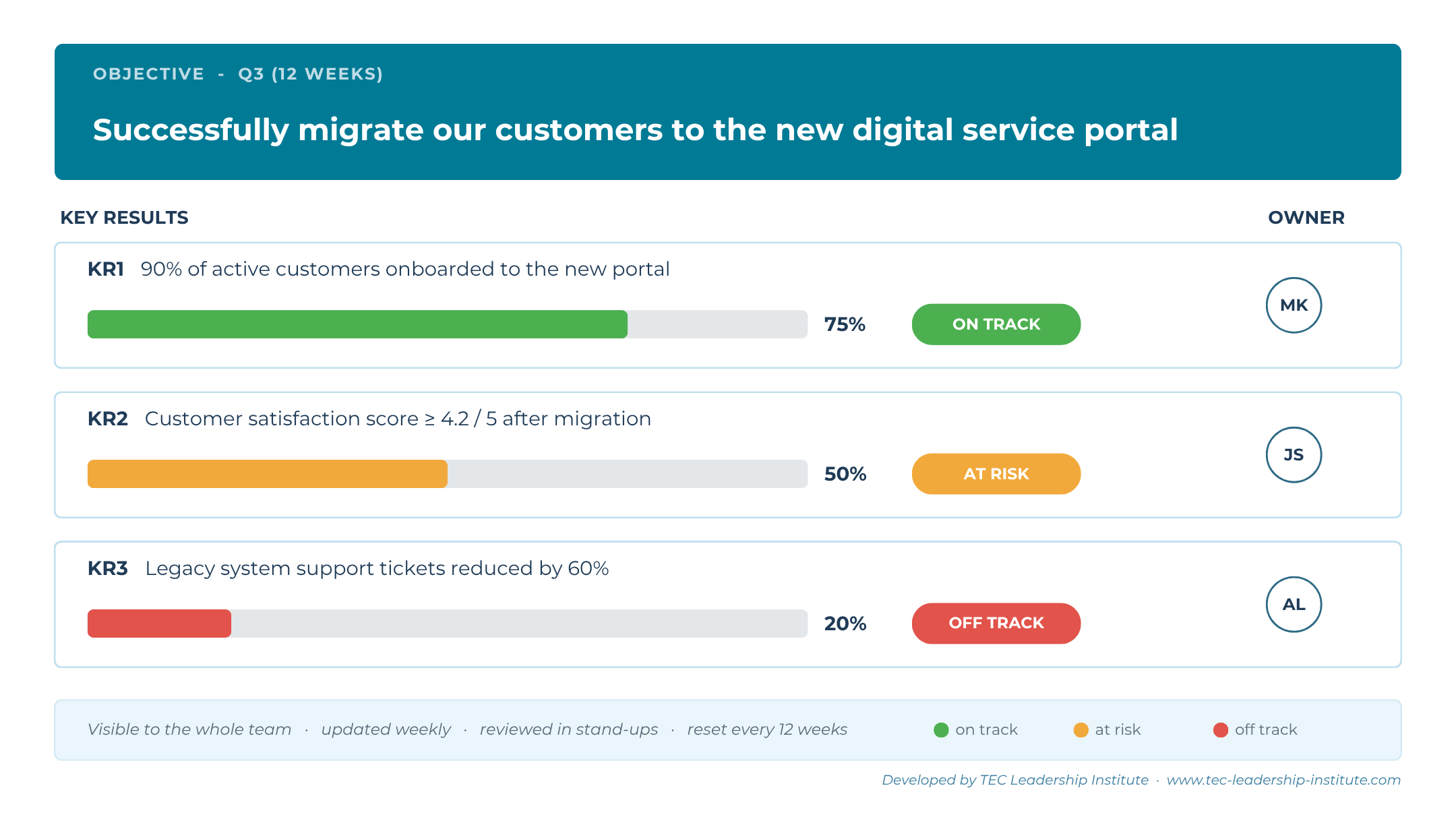
- Transparency and interdependencies. With a shared tracking tool, every team member’s key results are visible to everyone. Colleagues see where others stand, interdependencies surface early, and the classic traffic-light status – green (on track), orange (at risk), red (off track) – shows progress at a glance.
- Radically shorter meetings. Status meetings and agile stand-ups become far more effective: open the tracking board, see where everyone is without long explanations, and use the time to document setbacks and impediments – and remove them.
- Delivery discipline. Public, measurable commitments with a deadline create healthy peer accountability – OKRs gently force teams to deliver.
What it looks like
Tracking can be as simple as a shared board in Microsoft Teams, Planner or a spreadsheet; dedicated tools such as Quantive, Perdoo, Workboard, Weekdone or the OKR modules in Asana, Jira and monday.com add automated dashboards. A typical board looks like this:
Introducing OKRs: expect the adoption curve
Be honest with yourself and your team: at the beginning OKRs feel like additional work, and the benefit is not immediately visible. In our experience roughly 20% of a team will be genuinely delighted from day one, while the other 80% range from moderately enthusiastic to openly resistant. The key is to let those 20% – your ambassadors and first movers – demonstrate the benefit of the tracking. Once others see it working, adoption spills over quickly to 50%, then 70%, and the positive momentum pulls in the last resisters until OKRs are simply the norm. At companies like Google, Intel, LinkedIn, Adobe and Spotify, quarterly OKR cycles are exactly that – the normal way of working.
It does not have to be called OKRs. Related approaches carry the same DNA – the 4 Disciplines of Execution with its Wildly Important Goals, FAST goals (frequently discussed, ambitious, specific, transparent), or Salesforce’s V2MOM. Whatever the label, it is the mindset and methodology that count: a few clear objectives, measurable results, full transparency, and a regular rhythm. In times of major transformation with shifting corporate objectives, this is one of the most effective tools a leader can use – the key is not giving up in the early weeks.
Further reading
- Doerr, J. (2018). Measure What Matters. Portfolio/Penguin – the definitive book on OKRs, including the Intel and Google story.
- Locke, E. A. & Latham, G. P. (2002). Building a practically useful theory of goal setting and task motivation. American Psychologist, 57(9), 705–717 – the scientific foundation of goal setting.
- Grove, A. S. (1983). High Output Management. Vintage – where the original Intel management system behind OKRs is described by its creator.