
Knowing who you are dealing with – and how to move them
Download article here or below.
What is it?
The Change Adoption Curve is based on Everett Rogers’ Diffusion of Innovations (1962), one of the most researched models in social science. Rogers showed that any population adopts a new idea, tool or way of working in a predictable pattern: Innovators (2.5%), Early Adopters (13.5%), Early Majority (34%), Late Majority (34%) and, at the end, the Resistors (16%, Rogers’ “laggards”). Plotted cumulatively, adoption follows an S-curve: slow at first, then a steep climb once social proof kicks in, flattening into broad use.
For leaders, the curve is above all an analysis lens. Whether you are introducing SAP, sustainability goals, digital tools or a new operating model, ask: where is my team on this curve, and where are my stakeholders? In matrix and cross-disciplinary environments it is often not your own team you must lead through change, but the stakeholders who will have to use what you deliver. Map every person you need to convince, influence or involve onto the curve before choosing your strategy.
The five groups: mindset and behaviours
- Innovators (2.5%) – the mavens. Energised by the new; they drive the change, experiment early and tolerate imperfection. In meetings: “When can we start?”
- Early Adopters (13.5%) – the brokers. Respected opinion leaders who see the strategic benefit and connect people. Their visible endorsement is the single most valuable asset a change leader has.
- Early Majority (34%) – the pragmatists. Open, but they need evidence: working use cases and colleagues they trust already benefiting. “Show me that it works here.”
- Late Majority (34%) – the sceptics. Uncomfortable with uncertainty; they hold on to the familiar and adopt only when the new way has become the norm. Their resistance is usually anxiety, not analysis: “Why change what works?”
- Resistors (16%). Understand the why behind the resistance: fears, anxieties and, very often, political agendas – protecting status, territory or expertise. Objections are typically presented as unbiased and objective; your job is to distinguish reality-based objections (which are valuable and can improve the change) from fear-based or agenda-based ones (which will not be resolved by more facts).
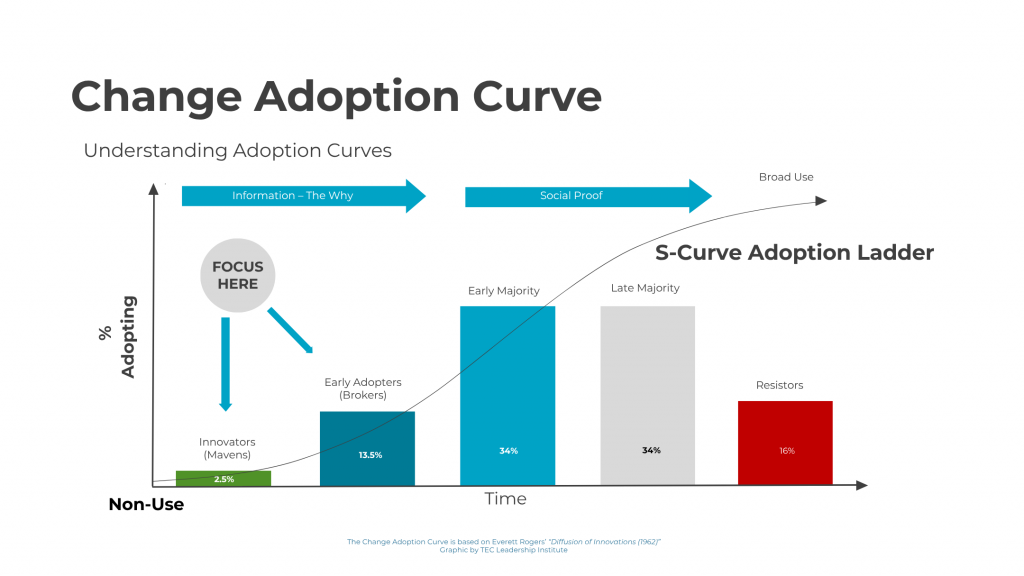
How to deal with each group
Focus your energy at the front. Work first and intensively with the Innovators and Early Adopters. With them, create the vision and the “why”, articulate concrete benefits, and build psychological safety so it is safe to try, fail and ask questions. Equip them as ambassadors: real use cases and demonstrated benefits – not abstract, philosophical arguments – are what they carry into the organisation.
Win the Early Majority through social proof. People are persuaded less by rational argument than by seeing peers they respect succeed (Cialdini’s principle of social proof). Combine influencing strategies: rational persuasion for the head, inspirational appeals for the heart, consultation (“help us shape it”) for ownership, and build powerful coalitions and networks across the matrix (Kotter’s guiding coalition), so the change arrives via trusted voices, not only from you.
Move the Late Majority by making it the norm. Reduce risk and effort: training, support, standards and clear expectations. Once 50% or more are visibly on board, the pull of the norm does much of the work.
With Resistors, analyse before you act. Find the root cause: listen genuinely, and separate legitimate concerns – use them to improve the change, from fear or political agendas, which need a different response: involvement where possible, clear non-negotiables where not.
What does not work: arguing rationally against emotional resistance, pressuring the late groups early, spending your energy on the loudest resistor while neglecting the silent majority, and relying on mass emails instead of trusted relationships.
Further reading
- Rogers, E. M. (2003). Diffusion of Innovations (5th ed.). Free Press – the original research behind the curve.
- Cialdini, R. B. (2021). Influence: The Psychology of Persuasion (new & expanded ed.). Harper Business – the science of positively influencing, including social proof.
- Kotter, J. P. (2012). Leading Change. Harvard Business Review Press – vision, guiding coalitions and anchoring change as the norm.
- Oreg, S. (2003). Resistance to change: Developing an individual differences measure. Journal of Applied Psychology, 88(4), 680–693 – the psychology behind why people resist.