
Competence – Character – Concern
What is it?
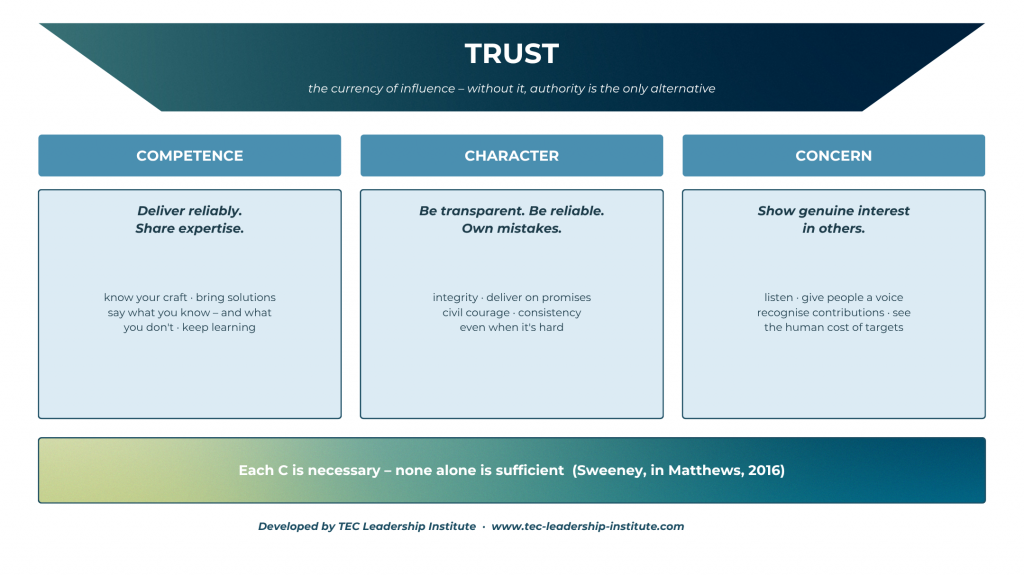
The Three Cs of Trust come from one of the most striking field studies in leadership psychology. In the early 2000s, military psychologist Colonel Patrick Sweeney surveyed soldiers during active combat operations to find out what made them trust their leaders. Three factors emerged – competence, character and caring (concern for the wellbeing of others) – and, crucially, each is necessary but none alone is sufficient: a brilliant leader without character is not trusted, and neither is a person of integrity who cannot do the job (Matthews, 2016, Psychology Today). The finding mirrors the most-cited academic model of trust, which identifies ability, integrity and benevolence as the three drivers of trustworthiness (Mayer, Davis & Schoorman, 1995).
Why it matters: trust is the currency of influence
In cross-functional, matrix environments you rarely have line authority over the people you need. Without trust, authority is the only alternative – and you usually don’t have it. Trust is what makes stakeholders take your call, prioritise your initiative and follow through on commitments. It also works as a diagnostic within your own team: when you see resistance, misaligned expectations or ignored follow-ups, these are rarely skills problems – they are usually trust deficits in disguise. Ask: which C is missing here, and for whom?
1. Building competence-based trust
Consider Captain Sullenberger and US Airways Flight 1549 in 2009. After a bird strike took out both engines, air traffic control offered him a return to LaGuardia or a diversion to Teterboro. Drawing on four decades of flying experience, Sullenberger judged that the aircraft would not make either runway, calmly declined, and landed on the Hudson River instead – a decision that investigators later vindicated, and for which he has since been recognised worldwide: sheer competence under extreme pressure, paired with the calm to rely on his own judgement. His passengers’ trust was earned retrospectively, and it rested on one C alone – not his character, but his competence. Ask yourself: where do my team and stakeholders trust me like that, based on what I have reliably delivered?
In today’s environment no one can be an expert in everything – and competence-based trust now includes the ability to say what you know and what you don’t. Far from being a weakness, “that’s beyond my area – I’ll find out for you” is reality-based self-confidence, and it feeds directly into your credibility. Two more building blocks: continuous learning, especially in the shifting AI landscape, and building a network of people who are competent where you are not – knowing who knows is a competence in itself.
2. Building character-based trust
Character-based trust can be summarised in one sentence: you do what you said you would do. It rests on integrity, reliability and delivering on your promises – and on civil courage: standing up for your team, and standing up for what is right, even at personal cost. Trust grows, and breaks, on how you behave when things get hard.
Industry offers instructive examples. When Alan Mulally was turning Ford around, his executives initially reported every project green despite the company losing billions. The first leader who dared to show a red status expected to be fired; instead Mulally applauded the honesty in front of everyone – and from that day the culture, and the trust, changed. A more extreme example: Patagonia founder Yvon Chouinard, who in 2022 gave the entire company to a trust so that its profits fund climate action – a decision that told every employee, customer and partner exactly what his word is worth. That is a very special case; few of us will ever be in such a position. But all of us are in a position, every single day, to keep our word, report the red status when it is red, own our mistakes, and be seen – consistently – as someone whose commitments hold.
3. Building concern-based trust
Concern for the wellbeing of others is not softness – it is what converts compliance into commitment. Google’s Project Aristotle, a multi-year study of what distinguishes its highest-performing teams, found that psychological safety – the confidence that you will not be exposed, blamed or ridiculed – mattered more than who was on the team. And psychological safety is built, or destroyed, by the leader’s daily behaviour.
In practice, concern-based trust means: never exposing anyone in a meeting – challenge in private, protect in public. No passive-aggressiveness, no steamrolling discussions. Acknowledging the human impact and the human cost of tough targets and shifting goalposts, rather than pretending they are free. Deliberately bringing in the quieter members of the team and valuing different styles and perspectives, so that everyone is heard and has a voice. Recognising contributions specifically – who did what, and why it mattered – not with generic praise. Sweeney’s research makes an important distinction here: caring does not mean catering to every wish; it means a demonstrated, consistent commitment to doing right by your people, especially under pressure. People can tell the difference – and they commit accordingly.
How to apply it
- Self-audit: for each C, ask “where am I strong, and where would my stakeholders say I am weak?” Better still – ask them.
- Diagnose relationships: when a stakeholder deprioritises you, ask which C is missing for them – then invest in their world before asking for theirs.
- Repair deliberately: competence gaps need delivery and follow-through; character gaps need owned mistakes and consistency over time; concern gaps need genuine listening – build the trust before you need the favour.
Further reading
- Matthews, M. D. (2016). The 3 C’s of Trust. Psychology Today – Sweeney’s combat field study of competence, character and caring.
- Mayer, R. C., Davis, J. H. & Schoorman, F. D. (1995). An integrative model of organizational trust. Academy of Management Review, 20(3), 709–734 – the classic academic model.
- Frei, F. X. & Morriss, A. (2020). Begin with Trust. Harvard Business Review, May–June – a practical framework for diagnosing and rebuilding your own trust wobbles.