
Clear on the destination, free on the route – designing teams for aligned autonomy
Download article here or below.
What it is – and where it comes from
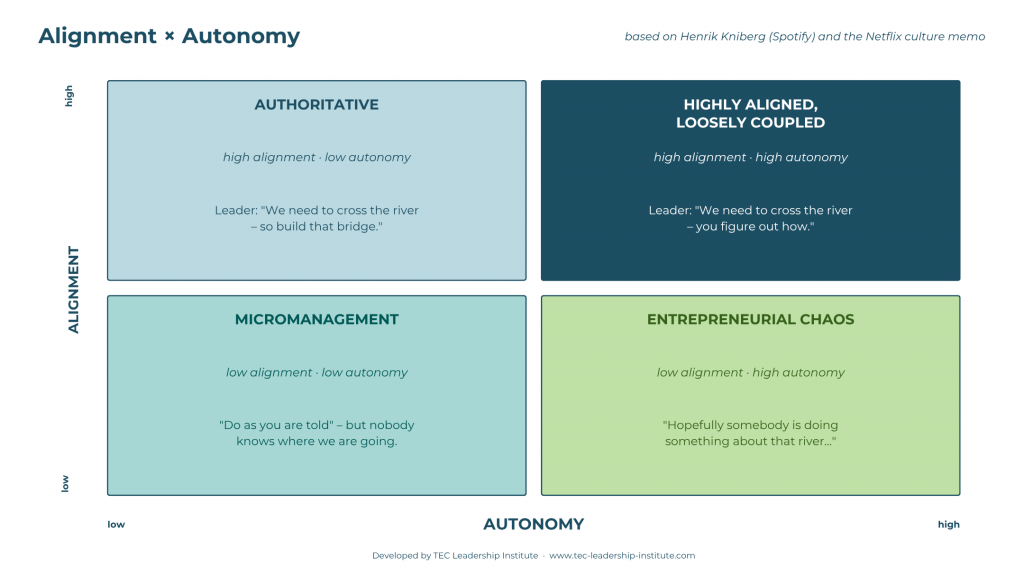
“Highly aligned, loosely coupled” describes an operating culture in which the organisation’s strategic objectives are crystal clear and non-negotiable – everyone is highly aligned on what must be achieved and why – while teams are loosely coupled in how they achieve it, deciding their own methods with minimal cross-team dependency. The phrase was coined by Netflix in Reed Hastings’ famous 2009 Culture Deck and lives on in the Netflix culture memo: strategy and goals are clear, specific and broadly understood; teams align on goals, not tactics; and groups trust each other without requiring constant approval. The complementary “aligned autonomy” model comes from agile coach Henrik Kniberg, who described Spotify’s engineering culture with a memorable image: the leader’s job is to say “we need to cross the river” – and the team’s job is to figure out how to build the bridge. From these two sources the culture has spread across most of the tech industry, and increasingly beyond it.
Why it matters in large, global matrix organisations
In an organisation of tens or hundreds of thousands of people, central control is simply too slow: decisions must be taken where the information sits. Highly aligned, loosely coupled makes that safe. Alignment on the non-negotiables – the strategic objectives and priorities – ensures thousands of autonomous decisions still pull in one direction; loose coupling removes the coordination overhead that paralyses matrix organisations. The benefits are speed, motivation (autonomy is one of the strongest intrinsic motivators – Pink, 2009), innovation at the edges, and resilience. It also connects directly to our article Leadership Tool: OKRs: objectives set the alignment; teams define their own key results – the how.
How to build it as a leader
- Fix the non-negotiables. Define and relentlessly communicate the strategic objectives, priorities and boundaries – the “we need to cross the river” message. Clarity here is what earns the right to let go elsewhere.
- Delegate the how – genuinely. Let teams choose their methods, tools and ways of working. Trust outcomes, not hours or presence.
- Create visibility, not control. Use OKRs and shared tracking tools so everyone can see goals, milestones and blockers – at the level required, and only that level – supported by an ongoing communication rhythm.
- Invest in connection. Deliberately create the social fabric – team events, rituals, and selective co-location moments – so autonomy never tips into isolation.
The challenges we see in practice
- Ownership of end-to-end results – the biggest one. Some individuals find comfort in clarity and want to be told how. The hard transition is rarely ownership of one’s own results; it is ownership of the end-to-end result, which requires aligning with others to deliver. Cultivating and supporting that shift is the leader’s core coaching task.
- Leadership style. Leaders used to giving directives – at worst micromanaging, at best specifying the how – struggle to let go, control hours and co-location instead of trusting outcomes. The model fails fastest here.
- Visibility. Without OKRs, shared tools and continuous communication, loose coupling degrades into blind spots. Everyone should know who is doing what, what has been achieved, and where the blockages are.
- Team culture. Loosely coupled can feel like “no team”. Counter it deliberately with social connection and moments of coming together.
- Overload. People contributing to multiple projects need visibility of their total workload – and the maturity to manage their own time and flag overload early, rather than saying yes to everything to appear collegial.
- Prioritisation. Measure what matters: have the discernment – and the permission – to let go of activities that no longer serve the bigger objectives, and to balance business-as-usual against the big, bold objectives.
What it requires psychologically
- High ownership and accountability for end-to-end results, not just one’s own deliverables.
- Cross-system alignment: the willingness and skill to align with others across boundaries.
- Empowering leadership: leaders who give clarity on the what and genuinely release the how.
- Strategic focus: clarity about – and discipline around – what matters most.
- Self-awareness and emotional intelligence: managing your own time, resources and balance in a system nobody manages for you.
Where it has proven successful
Netflix remains the reference case – the culture memo credits highly aligned, loosely coupled working for its ability to move fast at scale, a story told in full in Hastings and Meyer’s No Rules Rules. Spotify’s squad model made aligned autonomy famous in engineering. Amazon’s “two-pizza teams”, built on loosely coupled services with clear interfaces, follow the same logic, as does Google’s OKR-driven operating rhythm. The pattern is consistent: fix the what, free the how.
Further reading
- Hastings, R. & Meyer, E. (2020). No Rules Rules: Netflix and the Culture of Reinvention. Penguin – the full story behind the culture.
- Netflix Culture Memo – jobs.netflix.com/culture – the current, public statement of the highly aligned, loosely coupled principle.
- Kniberg, H. & Ivarsson, A. (2012). Scaling Agile @ Spotify. Whitepaper – the origin of the aligned-autonomy model and squad structure.
- Pink, D. H. (2009). Drive: The Surprising Truth About What Motivates Us. Riverhead – the motivation science behind autonomy, mastery and purpose.