
Five ways to handle conflict – and how to choose between them strategically
Download article here or below.
First: what is conflict?
Conflict is a natural disagreement arising when individuals or groups differ in attitudes, beliefs, values or needs. In organisations – and particularly in matrix organisations – it is structural: differing agendas, competing objectives, contested resources, budgets and standing mean that conflict will emerge, sometimes overtly, often covertly. And it is not always negative. Research distinguishes healthy task conflict – the productive clash of ideas that surfaces issues, tests assumptions and produces better solutions – from relationship conflict, which corrodes trust and wellbeing (Jehn, 1995). The goal is not to eliminate conflict, but to handle it well.
What shapes your default reaction
Left unexamined, our conflict behaviour is driven by three forces. Personality: where you sit on the Big Five agreeableness scale inclines you towards collaboration, competition or avoidance. National culture: some cultures engage conflict openly and directly (the United States is a classic example), while others – Japan among them – preserve harmony in the room and resolve differences in the background. Organisational culture: every company has norms about how much open competitiveness is acceptable and whether conflict is seen as fuel for performance or a threat to collaboration. All of these shape your default – but your default is not a strategy.
The TKI model: five modes, chosen intentionally
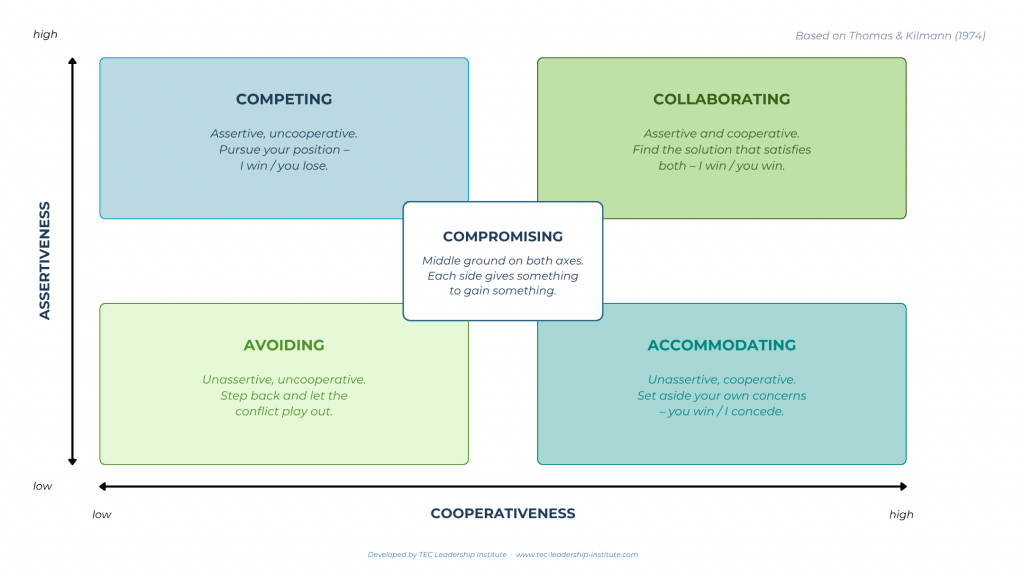
The Thomas-Kilmann Conflict Mode Instrument, developed by Kenneth Thomas and Ralph Kilmann in 1974, maps conflict behaviour on two dimensions: assertiveness (pursuing your own concerns) and cooperativeness (attending to the other party’s). The combination yields five modes:
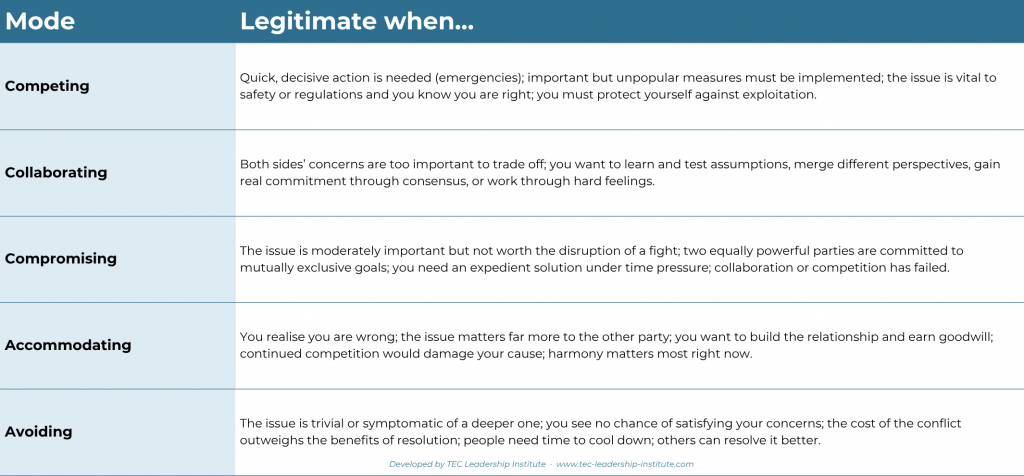
Every mode has its legitimacy
None of the five modes is inherently right or wrong – each is the best choice in certain situations and a costly mistake in others. The question is not “which mode is good?” but “which mode does this situation call for?”
Reflect
- What is my natural, default approach to conflict – and in which situations do I overuse it?
- Which of the five modes do I find most difficult – and what does that cost me and my team?
Managing conflict strategically: prepare, align, respond
The best conflict resolution happens before the meeting. When you can anticipate conflict with stakeholders, do the analysis in advance: what are the needs, values and pressures behind their position – not just what they are asking for, but why (Fisher & Ury’s classic distinction between positions and interests)? Build genuine empathy for those needs, and prepare a strategy to accommodate them where you can and counter them where you must. A leader who walks in understanding the other side’s world is far harder to destabilise.
Then align within your own team beforehand: which mode will we open with, and at what point will we deliberately shift – from avoiding to collaborating, or from collaborating to competing? Agreeing these trigger points in advance keeps the team coordinated and prevents individual personalities from taking over in the room. In the meeting itself, emotional intelligence does the rest: notice your reaction, regulate it, and choose your response. Handled this way, conflict behaviour is always responsive, never reactionary – a strategic decision, not a reflex of personality or cultural conditioning.
Further reading
- Thomas, K. W. & Kilmann, R. H. (1974). Thomas-Kilmann Conflict Mode Instrument. Xicom/CPP – the original instrument and model.
- Jehn, K. A. (1995). A multimethod examination of the benefits and detriments of intragroup conflict. Administrative Science Quarterly, 40(2), 256–282 – why task conflict helps and relationship conflict hurts.
- Fisher, R., Ury, W. & Patton, B. (2011). Getting to Yes (3rd ed.). Penguin – negotiating on interests, not positions.
- Meyer, E. (2014). The Culture Map. PublicAffairs – how cultures differ in confrontation and disagreement styles.