DIGITAL ARTICLE · 6 MIN READ
The leadership muscle for a world of unknown unknowns.
By TEC Leadership Institute GmbH
What is it?
Tolerance of Ambiguity (TOA) is the capacity to function effectively — to think, decide and lead — in situations that are unclear, incomplete or unpredictable. The concept was first proposed by psychologist Else Frenkel-Brunswik (1949) and given its classic scientific definition by Stanley Budner (1962), who described tolerance of ambiguity as “the tendency to perceive ambiguous situations as desirable”, and intolerance of ambiguity as the tendency to perceive them as sources of threat. In other words: faced with the same uncertain situation, one person sees danger and freezes; another sees possibility and moves.
Budner conceptualised TOA as a personality variable, and research confirms that some people are naturally born with a stronger tolerance than others. Yet psychologists today broadly agree that it is not fixed: like a muscle, it can be deliberately trained and strengthened through practice and exposure. This is what makes it a leadership skill — not just a trait.
Why it matters now: from VUCA to BANI
For decades we described our environment as VUCA — volatile, uncertain, complex, ambiguous. Futurist Jamais Cascio argued that this no longer captures today’s reality and proposed BANI: Brittle (systems that look strong but can snap), Anxious (a constant background of unease), Non-linear (small causes, disproportionate effects) and Incomprehensible (events that defy explanation). Geopolitical unrest, economic volatility, AI and technological disruption, and entirely new ways of doing business mean leaders now face not just known risks but unknown unknowns.
In this environment, TOA becomes a core leadership capability. Leaders with high TOA thrive personally — and, crucially, they create the psychological safety that lets their teams keep functioning. They are the ones who can lead a team through the woods, step by step, when nobody can yet see the other side.
How to recognise it: the language in the room
You can hear TOA in meetings. People with low tolerance stay with the problem and resist: “We can’t move until we have all the information.” “Why does everything keep changing?” “Let’s wait until things settle down.” People with high tolerance acknowledge the problem, then move through it: “We don’t have the full picture yet — what do we know, and what can we decide today?” “What does this change open up?” “What can we try first and learn from?” The tell-tale sign: high-TOA people do not remain in analysis of the problem — they shift into critical thinking and solutions.
The subskills of TOA
The subskills build on each other in a natural order — and it starts with calm. Much of the anxiety around change is based on future scenarios that have not happened; regulating that response first is what allows you to look at the situation through a calm lens. Only then can the thinking skills come into play:
• 1. Emotional awareness and self-regulation: being aware of your own and others’ emotions, and staying calm and focused rather than projecting and catastrophising.
• 2. Critical thinking: questioning assumptions, analysing and making sound judgements with incomplete data.
• 3. Systems thinking: seeing patterns, interdependencies and the bigger picture rather than isolated parts.
• 4. Productivity under uncertainty: continuing to deliver while the picture is still forming, rather than stalling.
• 5. Solution focus: moving beyond the problem towards what can be done, tried and tested.
All five are fuelled by internal stability: calm under uncertainty and change, composure under pressure, reality-based step-by-step thinking, and the vision and foresight to see what the future could look like — and lead the team towards it.
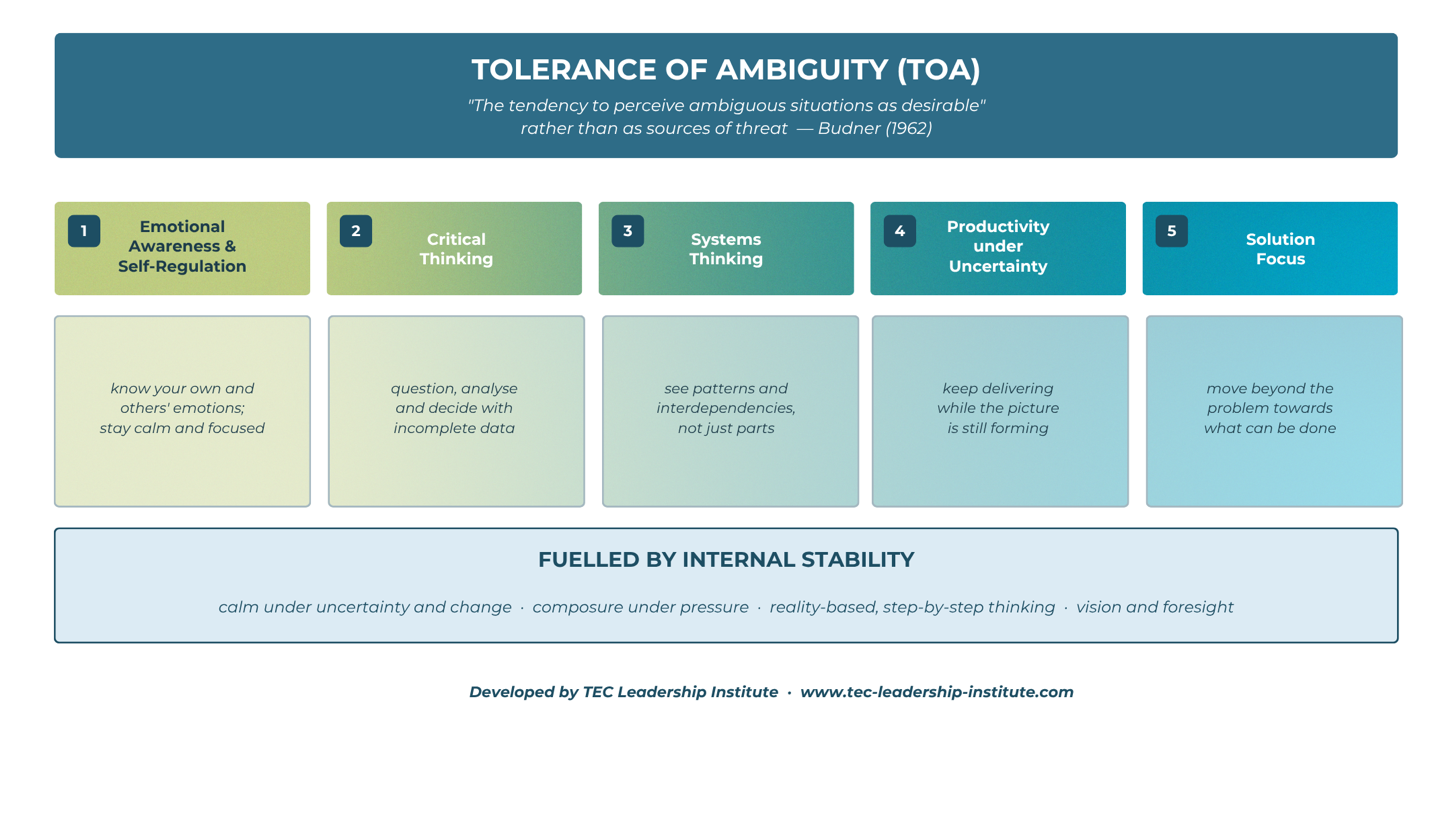
Tolerance of Ambiguity: definition, subskills and the stability that fuels them.
How to develop it
• Seek deliberate exposure. Volunteer for projects with unclear scope, rotate roles, work across disciplines — the muscle grows through use.
• Practise scenario thinking. Run regular “what if” exercises with your team; rehearsing multiple futures makes uncertainty familiar rather than threatening.
• Decide at 70%. Timebox decisions and act on good-enough information; run small, reversible experiments instead of waiting for certainty.
• Change the language. Replace “we don’t know” with “here is what we do know, and here is what we will test next.” Leaders who name uncertainty openly while committing to next steps build psychological safety.
• Train self-regulation. Breathing, mindfulness and recovery routines keep emotions in check and critical thinking available under pressure.
• Debrief every change. Ask: what did we expect, what actually happened, what did we learn? Each cycle builds the team’s confidence that it can navigate the unknown.
Further reading
• Budner, S. (1962). Intolerance of ambiguity as a personality variable. Journal of Personality, 30(1), 29–50 — the original definition and scale.
• Furnham, A. & Marks, J. (2013). Tolerance of ambiguity: A review of the recent literature. Psychology, 4(9), 717–728 — open-access review of 50 years of research.
• Furr, N. & Furr, S. H. (2022). The Upside of Uncertainty. Harvard Business Review Press — practical strategies for turning the unknown into opportunity.