The capstone of our leadership tools series – developed for the Siemens Sustainability Summit
Download article here or below.
Why a capability framework?
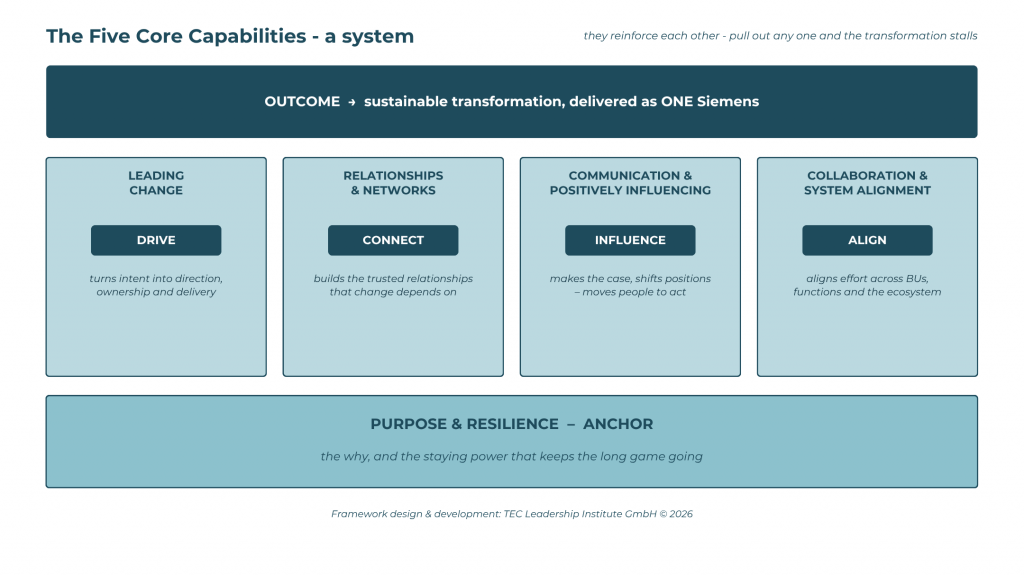
Delivering a long-horizon transformation – like Siemens’ sustainability ambition – is not a matter of one heroic skill. It asks leaders to hold the “why” when progress is slow, to turn strategy into owned delivery, to build trust across an ecosystem, to make the case persuasively under pressure, and to align effort across businesses and functions. The Five Core Capabilities framework, developed for the Siemens Sustainability Summit, names these five and – crucially – treats them as a system: they reinforce each other, and pulling out any one of them stalls the transformation. This page is your “read more” after the Summit: each capability below links to the practical tools in our series that build it.
The five capabilities in brief
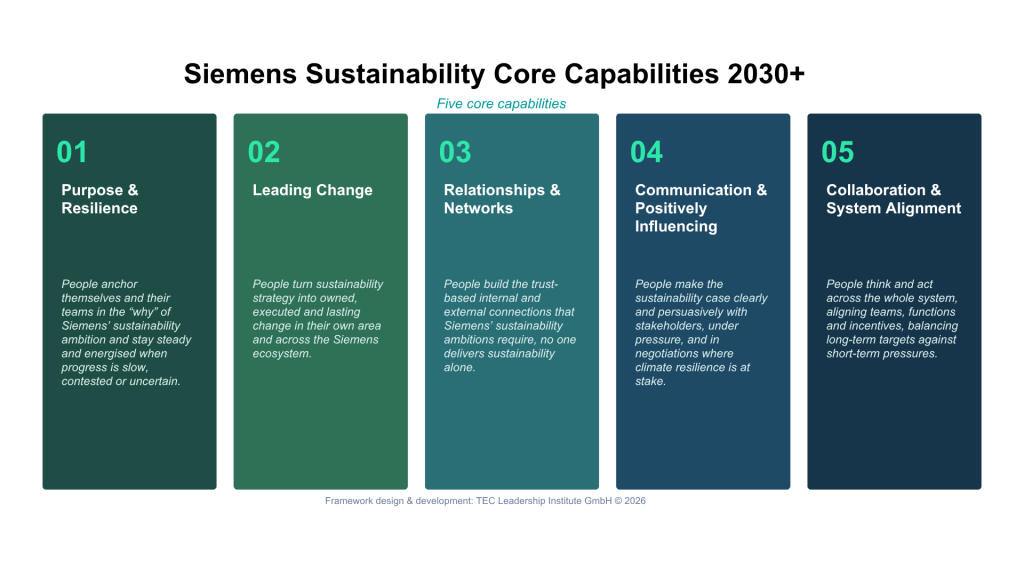
| 1 · ANCHOR | Purpose & Resilience People anchor themselves and their teams in the “why” of the sustainability ambition and stay steady and energised when progress is slow, contested or uncertain. |
| 2 · DRIVE | Leading Change People turn sustainability strategy into owned, executed and lasting change in their own area and across the ecosystem. |
| 3 · CONNECT | Relationships & Networks People build the trust-based internal and external connections that the ambition requires — no one delivers sustainability alone. |
| 4 · INFLUENCE | Communication & Positively Influencing People make the sustainability case clearly and persuasively — with stakeholders, under pressure, and in negotiations where climate resilience is at stake. |
| 5 · ALIGN | Collaboration & System Alignment People think and act across the whole system, aligning teams, functions and incentives, balancing long-term targets against short-term pressures. |
The architecture: from capabilities to tools
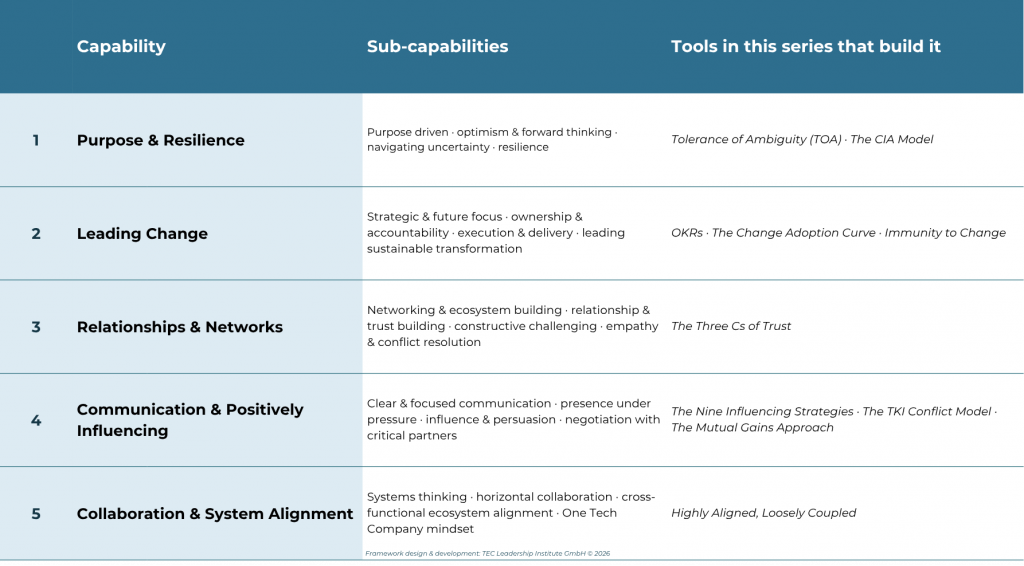
Each capability breaks down into four sub-capabilities – concrete, observable behaviours – and each is built by specific, practical tools covered in this series. Use the table as your development map: identify the capability you most want to strengthen, then work through its tools.
How to use this after the Summit
- Self-assess. Read the five descriptors above and ask: which capability is my strongest, and which one, if I strengthened it, would most change what I can deliver? Ask a trusted colleague the same question about you.
- Go deep on one. Pick one capability for the next quarter, and read the two-page tools linked to it, each gives you the model, the science behind it, and concrete steps to apply with your team.
- Work it like a system. If a change is stalling, diagnose which capability is the bottleneck. Resistance in the organisation? Look at Influence and Connect. Energy fading? Return to the Anchor. Everyone busy but nothing landing? Drive and Align.
- Bring it to your team. The capabilities are not only individual, run the same self-assessment as a team conversation, and agree the one capability you will build together.
About this framework
The Five Core Capabilities framework was designed and developed for the Siemens Sustainability Summit, drawing on the research base behind each tool in this series, from goal-setting and trust research to the psychology of change, influence and negotiation. The full sources are listed in the individual tool articles linked above.