
Five Core Capabilities Skills – the behavioural descriptor, the sub-capabilities and what they mean, the specific skills that build them, and the named sources and go-to books for extended reading.
Download here or at the end.
Purpose & Resilience · THE ANCHOR
People anchor themselves and their teams in the “why” of Siemens’ sustainability ambition and stay steady and energised when progress is slow, contested or uncertain.
The skills in depth
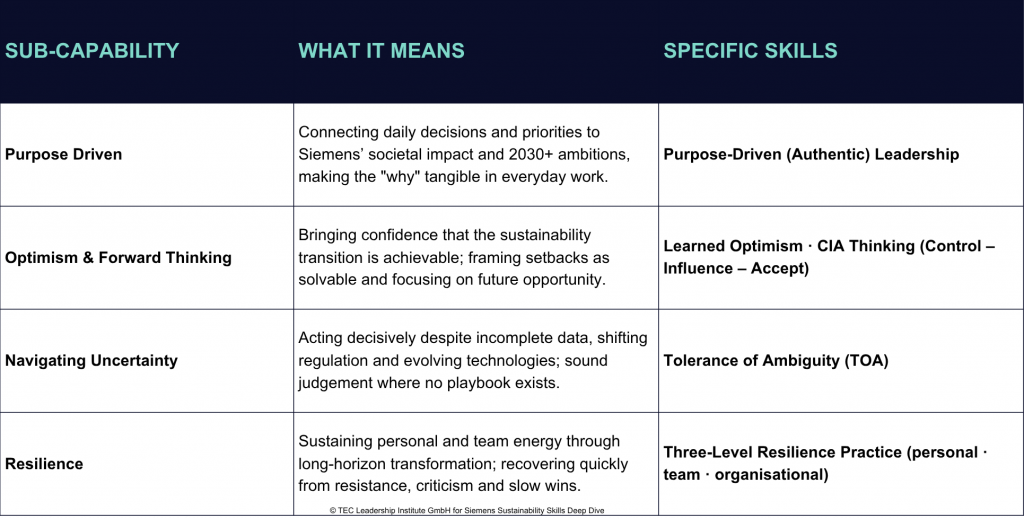
Purpose-Driven Leadership — Connect your role — and your team’s — to the sustainability agenda and Siemens’ wider transformation journey. The test: is your calendar dominated by business-as-usual, or are you protecting time for the strategic part of your role? Authentic-leadership practice grounds purpose in your own values and life story, not borrowed slogans.
↳ Go deeper: Bill George, True North and Discover Your True North (the go-to books on authentic, purpose-driven leadership).
Learned Optimism — In a BANI environment, optimism is not naïve positivity — it is a trained explanatory style: an optimism mindset versus a victim (learned-helplessness) mindset, believing the future can be navigated and choosing where to put your energy.
↳ Go deeper: Martin Seligman, Learned Optimism — the founding research on optimism vs. learned helplessness.
CIA Thinking (Control · Influence · Accept) — Focus deliberately on what you can Control and Influence rather than being drained by what you can only Accept. Forward thinking then asks: where does sustainability need to be three years from now — and are the OKRs in place to get there?
↳ Go deeper: Stephen R. Covey, The 7 Habits of Highly Effective People (Circle of Influence / Circle of Concern).
Tolerance of Ambiguity (TOA) — Arguably the most important skill for this moment: keep deciding and moving when the picture is not clear. Gauge how high your own tolerance of ambiguity is, then deliberately strengthen the muscle — small decisions taken with 70% of the information.
↳ Go deeper: S. Budner (1962), “Intolerance of Ambiguity as a Personality Variable”, Journal of Personality — the original TOA scale.
Three-Level Resilience Practice — Resilience works on three levels: personal (work-life balance, solution focus over problem focus), team and cultural (support systems and stakeholder networks that carry you through), and organisational (the sustainability agenda is itself fundamental to Siemens’ long-term resilience).
↳ Go deeper: Karen Reivich & Andrew Shatté, The Resilience Factor (Penn Resilience Program — the applied companion to Seligman’s research).
Leading Change · THE ENGINE
People turn sustainability strategy into owned, executed and lasting change in their own area and across the Siemens ecosystem.
The skills in depth
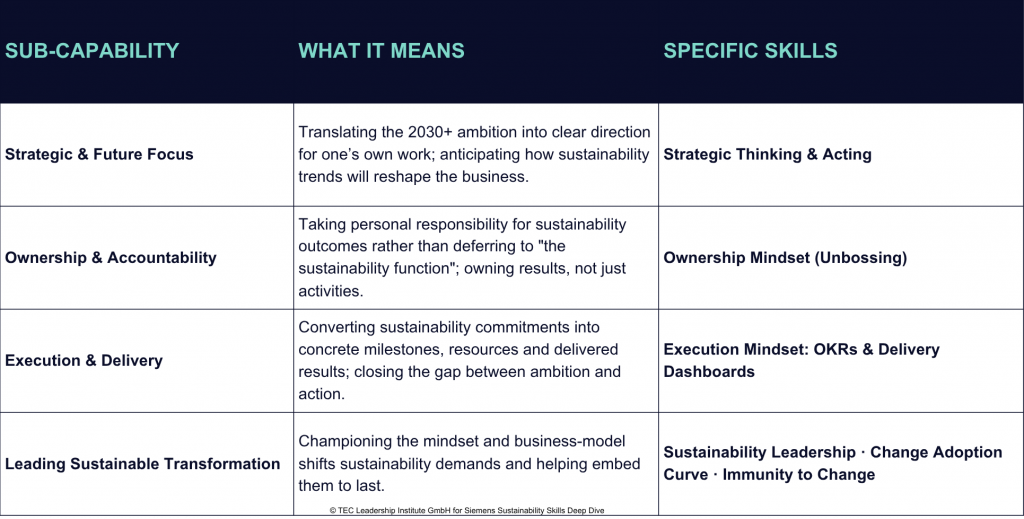
Strategic Thinking & Acting — Be clear on the organisation’s strategic focus, and make sure your core activities — and your collaboration with others — are genuinely dedicated to it, not quietly absorbed by business-as-usual. Strategy is a set of explicit choices: where to play, and how to win.
↳ Go deeper: A.G. Lafley & Roger L. Martin, Playing to Win: How Strategy Really Works.
Ownership Mindset (Unbossing) — Build ownership across teams and your stakeholder group, alongside your own end-to-end accountability for the sustainability agenda. The enemy is siloed thinking; the work is cultivating shared ownership so the agenda gets delivered together — leaders as enablers, not gatekeepers.
↳ Go deeper: Lars Kolind & Jacob Bøtter, Unboss — the source of the unbossing / shared-ownership movement. Complementary: Jocko Willink & Leif Babin, Extreme Ownership.
Execution Mindset: OKRs & Delivery Dashboards — Strategic focus routinely gets pulled back into business-as-usual — which is why execution discipline matters. Use OKRs and dashboards to make delivery visible, and hold each other accountable for high-quality outcomes on the sustainability agenda.
↳ Go deeper: John Doerr, Measure What Matters — the go-to book on OKRs (Intel/Google lineage).
Leading Sustainable Transformation — You are the group accountable for driving this: deal with the resistance that will inevitably show up, and see yourselves as facilitators of the change rather than waiting for it. Diagnose where people sit on the adoption curve, and surface the hidden commitments behind their resistance.
↳ Go deeper: Henrik Henriksson & Elaine Weidman-Grunewald, Sustainability Leadership; Paul Polman & Andrew Winston, Net Positive; Isabel Rimanoczy, The Sustainability Mindset Principles. On change itself: Everett Rogers, Diffusion of Innovations (adoption curve) and Robert Kegan & Lisa Lahey, Immunity to Change.
Relationships & Networks · CONNECT
People build the trust-based internal and external connections that Siemens’ sustainability ambitions require — no one delivers sustainability alone.
The skills in depth
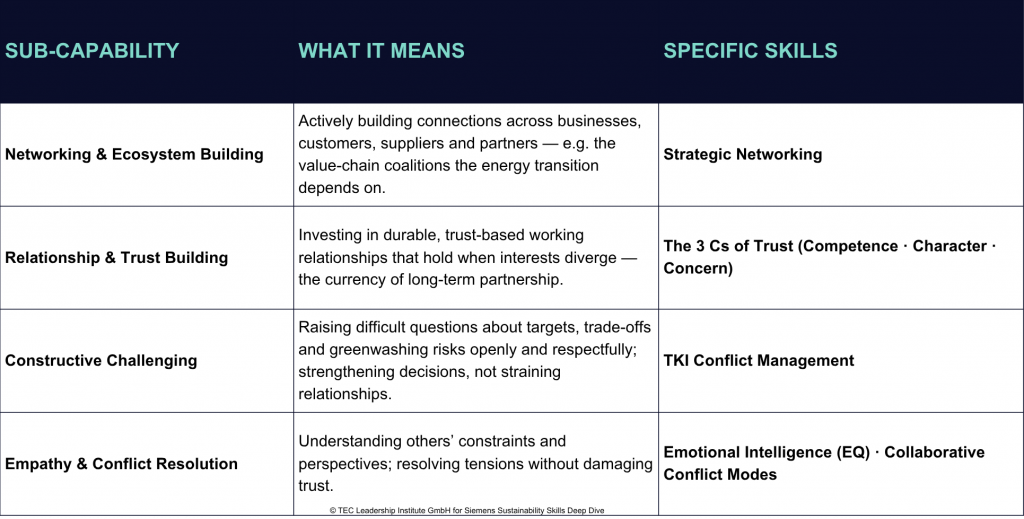
Strategic Networking — Build the relationships and coalitions across the organisation — and the external ecosystem — that the sustainability agenda depends on. Distinguish operational, personal and strategic networks, and deliberately invest in the strategic one: you are assembling the network that makes delivery possible.
↳ Go deeper: Herminia Ibarra, Act Like a Leader, Think Like a Leader — the standard work on strategic networking for leaders.
The 3 Cs of Trust — Show up with Competence, Character, and Concern for others — the three pillars on which trust is built. The through-line: we are doing this together. Trust is built in observable behaviours, and it compounds: high-trust relationships move faster and cost less.
↳ Go deeper: Academic root: Mayer, Davis & Schoorman (1995), the ability–benevolence–integrity trust model (Academy of Management Review). Go-to book: Stephen M.R. Covey, The Speed of Trust.
TKI Conflict Management — Conflict can and should be collaborative rather than competitive — and avoidance is not an option. The TKI maps five modes: Competing, Collaborating, Compromising, Avoiding, Accommodating. Aim to operate predominantly in the collaborative zone, and when you meet resistance, deal with it constructively by understanding what is behind it.
↳ Go deeper: Kenneth W. Thomas & Ralph H. Kilmann, the Thomas-Kilmann Conflict Mode Instrument (TKI) — the source model and assessment.
Empathy & Emotional Intelligence (EQ) — Collaborative conflict resolution takes real empathy with your stakeholders — their challenges, what is holding them back, and their immunity to change. Tailor communication to the audience, help them see what is in it for them, and stay empathetic to the competing demands on their time.
↳ Go deeper: Daniel Goleman, Emotional Intelligence and Primal Leadership (with the EQ-i / ESCI assessment tradition). Pair with Kegan & Lahey, Immunity to Change, to decode resistance.
Communication & Positively Influencing · INFLUENCE
People make the sustainability case clearly and persuasively — with stakeholders, under pressure, and in negotiations where climate resilience is at stake.
The skills in depth
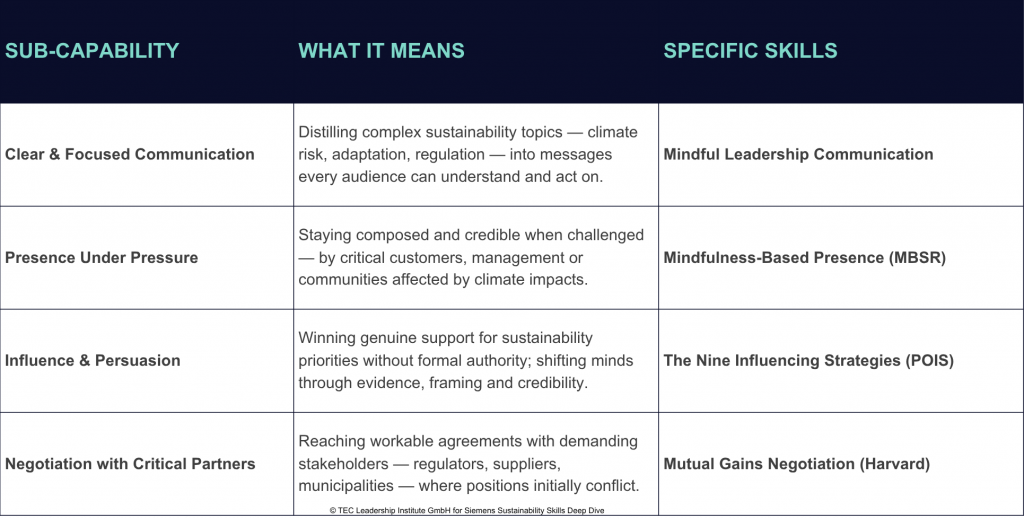
Mindful Leadership Communication — It starts with clarity: are you leading your interactions and meetings with clarity and focus — which links straight back to purpose? Marturano’s discipline of “finding the space” trains leaders to communicate with focus, clarity, creativity and compassion rather than on autopilot.
↳ Go deeper: Janice Marturano, Finding the Space to Lead (Institute for Mindful Leadership).
Presence Under Pressure — To be credible as a partner, stay calm under pressure, manage your impulses, and avoid reacting emotionally. Mindfulness practice builds the pause between stimulus and response — guiding people with deliberate responses rather than reactions.
↳ Go deeper: Jon Kabat-Zinn, Full Catastrophe Living (MBSR — Mindfulness-Based Stress Reduction) and Wherever You Go, There You Are.
The Nine Influencing Strategies (POIS) — We all lead without line authority, so influence is the single biggest currency. Consciously choose your strategy — inspirational appeal, personal appeal and empathy, consultation with stakeholders across the business, coalition-building — rather than defaulting to reason or pressure.
↳ Go deeper: David Kipnis & Stuart Schmidt, Profiles of Organizational Influence Strategies (POIS) — the source research. Complementary go-to book: Robert Cialdini, Influence: The Psychology of Persuasion.
Mutual Gains Negotiation — Treat conflict with critical partners as negotiation: focus on what we gain mutually and reciprocally, moving stakeholders from “me-first” to “enterprise-first” thinking. Bring a structured approach — preparation, strategy, a focus on the people, and your behaviours in the room.
↳ Go deeper: Roger Fisher & William Ury, Getting to Yes (Harvard Program on Negotiation); the formal Mutual Gains Approach: Lawrence Susskind (MIT–Harvard), Good for You, Great for Me and Built to Win.
Collaboration & System Alignment · ALIGN
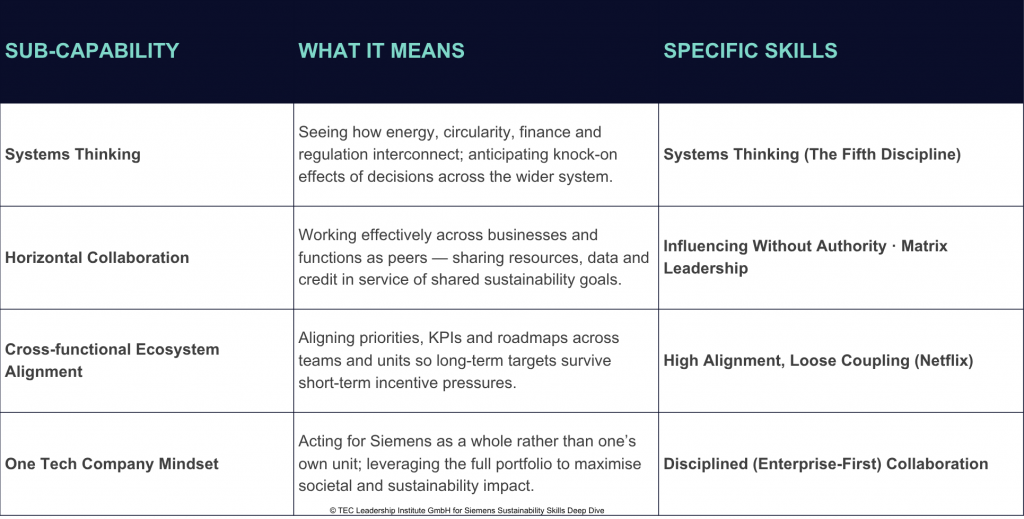
People think and act across the whole system — aligning teams, functions and incentives, balancing long-term targets against short-term pressures.
The skills in depth
Systems Thinking — Think in systems rather than silos: delivering the One Tech journey means seeing the whole and working end-to-end, not optimising your own corner. Learn to spot reinforcing loops, delays and unintended consequences before they surprise you.
↳ Go deeper: Peter Senge (MIT), The Fifth Discipline — the go-to book. Complementary: Donella Meadows, Thinking in Systems.
Influencing Without Authority & Matrix Leadership — The One Tech transformation requires horizontal collaboration — showing up across boundaries and focusing on shared objectives rather than local ones. In a matrix, currencies of exchange (resources, information, recognition) replace line authority.
↳ Go deeper: Allan Cohen & David Bradford, Influence Without Authority — the standard work on matrix and lateral leadership.
High Alignment, Loose Coupling — Be highly aligned on the why and the what — the sustainability objectives and Siemens’ transformation objectives — and loosely coupled (autonomous) on the how. Alignment on context, not control of execution, is what lets a large system move fast without fragmenting.
↳ Go deeper: Reed Hastings & Erin Meyer, No Rules Rules (2020) — the recognised book on the Netflix model. Also: Patty McCord, Powerful, and the original 2009 Netflix Culture Deck.
Disciplined, Enterprise-First Collaboration — The One Tech Company mindset ties it all together: deliver the sustainability agenda as one company, aligned across the system, rather than as competing parts. Collaborate where it creates value, decline where it does not — and always count the enterprise result, not the unit result.
↳ Go deeper: Morten T. Hansen, Collaboration: How Leaders Avoid the Traps, Build Common Ground, and Reap Big Results.