Future-Fit Leadership:
From Capability Insight to Organisational Impact
Why Organisations Need A Future‑Fit Diagnostic Now
Organisations today operate in conditions of constant change, uncertainty, and complexity.
Leaders are expected to navigate AI, hybrid work, cultural diversity, talent scarcity, and shifting expectations, often without a clear framework for identifying which leadership capabilities truly matter most.
At the same time, Chief Learning Officers, L&D leaders, and Talent Development teams are under increasing pressure to design learning paths that build the leadership capabilities required for the future of the organisation, while demonstrating relevance, focus, and impact.
Yet many organisations are overwhelmed by initiatives, models, and leadership data that generate volume but not clarity. Everything becomes a priority, and leadership development risks becoming broad, unfocused, and disconnected from real business needs.
This is the gap Future-Fit Leadership (FFL) was designed to address.
What Is Future-Fit Leadership?
Future‑Fit Leadership (FFL) is TEC Leadership Institute’s flagship diagnostic and development framework for leadership and talent in global, matrixed organisations.
FFL was developed by TEC Leadership Institute in collaboration with the Organisation Behavior Change Consultancy Group at the University of Twente and builds on:
- over 35 years of leadership development practice
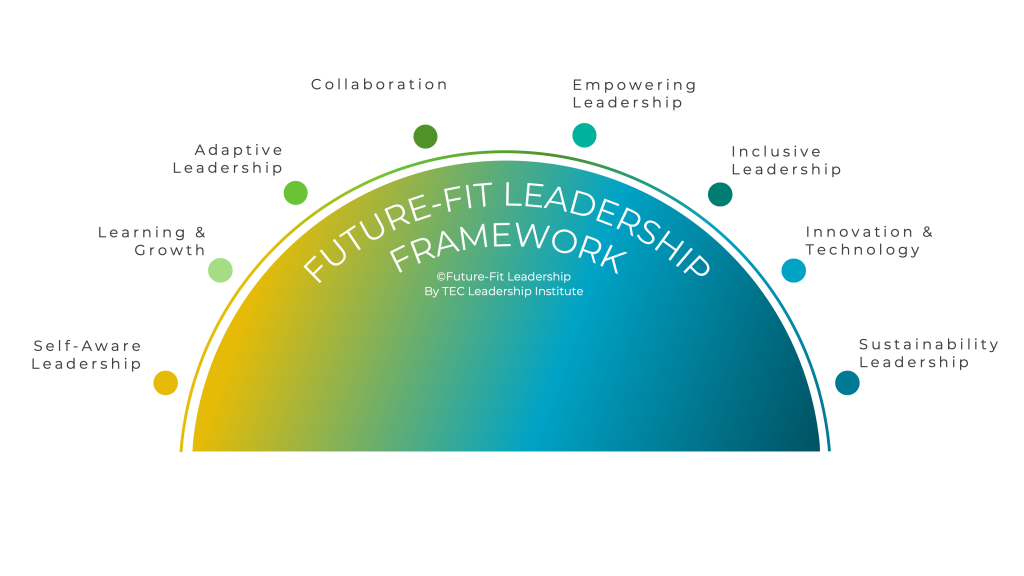
- a coherent framework of 8 core leadership capabilities
- 40 sub‑capabilities grounded in scientifically validated behavioural scales
FFL combines academic insight with deep practitioner experience across industries and organisational contexts to support strategy, culture development, and leadership capability building.
A Future‑Fit Diagnostic For Leadership & Talent Decisions
Future‑Fit Leadership (FFL) is not a traditional psychometric leadership assessment and does not aim to predict individual performance or potential against static competencies.
Instead, FFL is a dynamic future‑capability diagnostic designed to help organisations gain clarity, prioritise development, and make better leadership and talent decisions in conditions of complexity and change.
FFL focuses on capabilities, observable, learnable behaviours that shape how leaders:
- reflect
- think and decide
- relate and collaborate with others
- act effectively in real work situations
A Capability‑Based Approach to Leadership
Leadership effectiveness is driven by capabilities, not traits.
FFL defines leadership through:
- 8 core capabilities critical for navigating complexity and change
- 40 sub‑capabilities that translate leadership into concrete, observable behaviour
This creates a shared, practical leadership language that can be applied consistently across teams, functions, and countries.
At the same time, FFL makes visible the systemic interplay between capabilities, highlighting where leadership strength already exists, where critical gaps are emerging, and which capabilities need to be developed in focus to lead effectively in the future of work.
From Future‑Fit Data to Development Direction
The FFL diagnostic provides structured, comparative insight into:
- current leadership and talent capability profiles
- capability gaps relevant to future strategy and operating models
- patterns across individuals, teams, and cohorts
- areas where development investment will have the greatest impact
The output is directional and decision‑enabling.
FFL helps organisations answer questions such as:
- Which leadership capabilities matter most for where we are going?
- Where should development effort be focused, and where not?
- How aligned are leaders around a shared understanding of effective leadership?
These insights translate directly into focused learning journeys, leadership programmes, and capability‑building initiatives.
Why Capability‑Focused Development Matters Now
Many organisations already have leadership and talent data.
What is often missing is clarity on:
- which capabilities matter most next
- where to focus development energy
how to avoid broad, generic programmes
Future‑Fit Leadership closes this gap by:
- identifying priority capabilities based on future demands
- making capability patterns visible across individuals, teams, and cohorts
- guiding targeted upskilling rather than one‑size‑fits‑all development
The result is development that is focused, relevant, and far more likely to stick.
What FFL Enables Organisations To Do
Talent Upskilling (individual capability focus)
FFL supports organisations in:
- creating individual capability profiles to guide targeted development
- prioritising high‑impact upskilling for key talent pools and critical roles
- supporting role transitions by clarifying capability focus for success
- enabling consistent development conversations through a shared capability language
Leadership Development (individuals and cohorts)
FFL helps organisations in:
- establish a shared understanding of effective leadership
- ground leadership programmes in real capability strengths and gaps
- focus development on the few capabilities that matter most next
- align leadership development with future strategy and operating realities
Organisational Capability Building (system level)
At a broader level, FFL is used to:
- make capability patterns visible across teams, functions, and regions
- identify systemic strengths, gaps, and emerging capability risks
- inform capability academies and integrated learning journeys
- support transformation and change initiatives with a clear capability focus
From Capability Insight To Organisational Impact
Organisations using FFL experience:
- clearer capability priorities linked to future demands
- more focused, targeted development strategies
- stronger alignment around a shared understanding of effective leadership
- improved collaboration and cultural coherence
- reduced initiative overload through clearer development focus
Future‑Fit Leadership helps organisations translate future‑capability insight into practical capability development — enabling focus, clarity, and intent in how leadership and talent are developed for what’s next.
FFL is grounded in scientifically validated behavioural scales and was developed by TEC Leadership Institute in collaboration with the Organisation Behavior Change Consultancy Group at the University of Twente, combining academic insight with over 35 years of applied leadership development practice.