Leadership Tool: The Leadership Maturity Model
DIGITAL ARTICLE · 7 MIN READ
Why the wisdom leaders once developed over a lifetime now has to arrive much earlier.
By TEC Leadership Institute GmbH
What is leadership maturity?
Most leadership development targets horizontal growth: new skills, frameworks and competencies layered onto how a person already thinks. Leadership maturity is different. It is vertical: not what a leader knows, but the complexity of mind they bring to knowing it, how many perspectives they can hold at once, how well they tolerate ambiguity and contradiction, and whose interests they instinctively factor in when they decide.
Two leaders with identical CVs, the same qualifications and the same years in role, can operate at very different levels of maturity. One reads setbacks as threats to defend against; the other reads them as data. Adult development researchers such as Robert Kegan and Susanne Cook-Greuter have spent decades mapping this dimension, and it turns out to be one of the strongest predictors of how a leader performs under real complexity, not just under normal conditions.
Five stages, one journey
Leadership maturity unfolds through recognisable stages, not a straight line of tenure. The model below adapts Susanne Cook-Greuter’s ego development research, as further developed by the Vertical Development Academy and Leadership Circle, to organisational leadership.
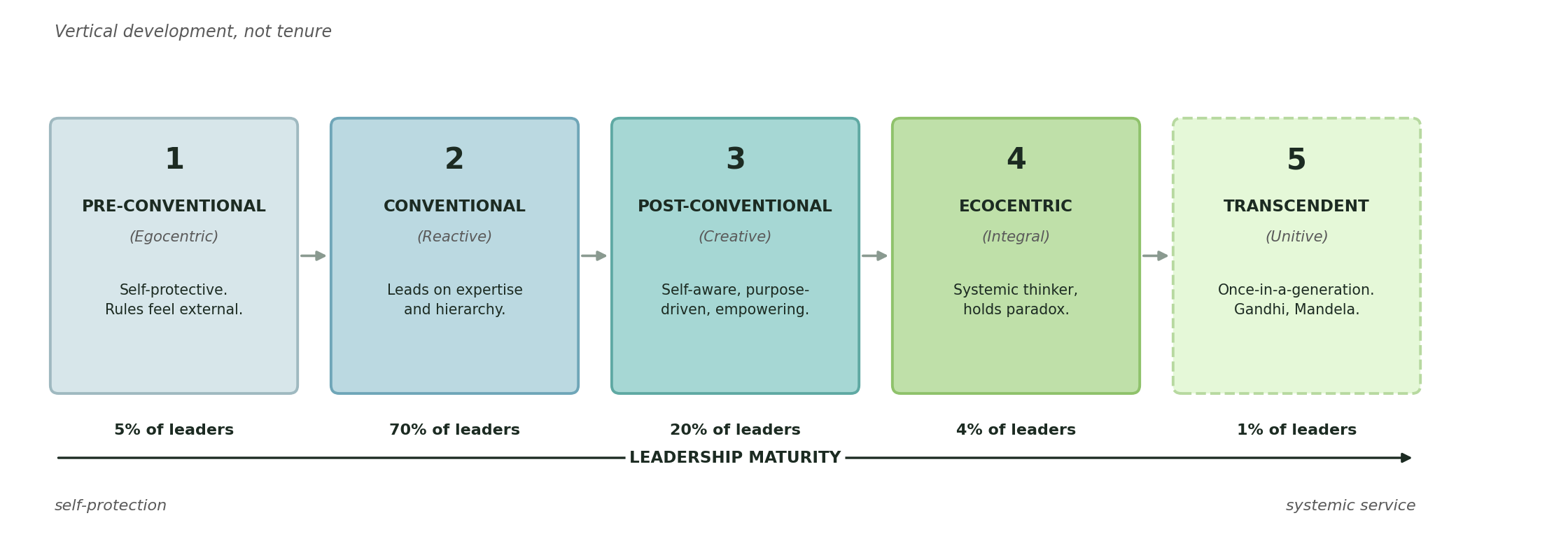
The five stages of leadership maturity, and the share of leaders typically found at each. Adapted from S. Cook-Greuter’s Ego Development Model, via the Vertical Development Academy, Leadership Circle and the Future-Fit Leadership Community.
The great majority of leaders (roughly seven in ten) operate at the Conventional stage: capable and hard-working, but reliant on expertise and hierarchy to manage complexity. Post-Conventional leaders have made the shift Kegan calls “subject-to-object”: they can examine their own assumptions rather than being run by them. Ecocentric and Transcendent leadership are rare by definition and, for most organisations, not a realistic target for a development programme; they’re included here for completeness, not as a checklist.
What moves a leader forward
Stage shift | What tends to move a leader forward |
Pre-Conventional → Conventional | Structure, clear consequences, and a first real experience of being accountable for someone else’s outcome. |
Conventional → Post-Conventional | Unfiltered feedback from people with nothing to gain from flattering you; a crucible that expertise alone can’t solve; sustained reflection practice, such as coaching, experiential learning and 360 degree review, rather than a one-off assessment. |
Post-Conventional → Ecocentric | Responsibility that stretches beyond your own team, function or organisation, because these leaders cannot be contained within one system; practice holding two good but conflicting options rather than resolving them prematurely; a pull toward the wider world and community, where these leaders give back, act on a broader stage, and are increasingly sought out rather than formally appointed. |
A shorter runway
Bill George, whose True North framework anchors much of our leadership journey work, divides a career into thirds: roughly the first thirty years preparing to lead, the next thirty (30 to 60) leading, and a final third, from about 60 onward, as a “wisdom period” spent giving back. It’s an elegant arc, but it assumes a runway most of today’s leaders no longer have: a lifetime to grow into wisdom, one stage at a time. Tenures are shorter, industries turn over faster, and organisations need generative, self-aware leadership from people who are nowhere near any traditional retirement stage.
Our view, based on more than thirty years of leadership exposure and development: we cannot simply accelerate maturity itself, but we can accelerate the conditions that make it more likely: responsibility, challenge, honest feedback, reflection, and early exposure to real complexity. The goal was never to arrive at the Generativity stage on schedule; it is to have done enough of the inner work that a leader can operate at Post-Conventional maturity, mentoring others and building systems rather than just managing them, much earlier than tradition once assumed, while they still have real organisational reach left to use it. What has shifted is not just timing but scale: leading self gives way to leading others, and leading others gives way to leading the business, and today those transitions are asked of people years before they would once have been considered ready for them.
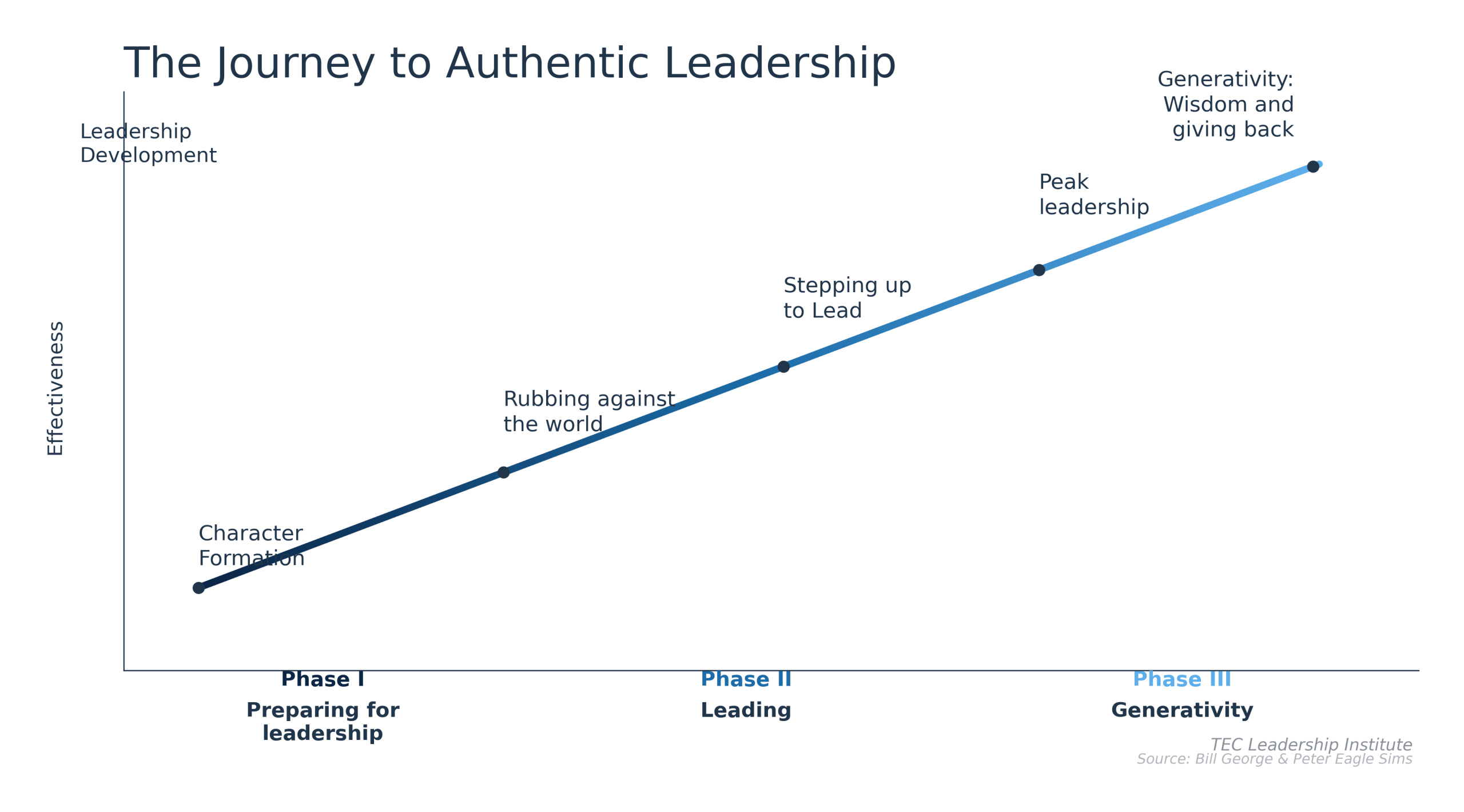
Bill George’s Journey to Authentic Leadership, from character formation through to generative wisdom and giving back. Adapted from George, B. (2015), Discover Your True North.
The complexity leaders are asked to hold, and the challenges that come with it, now arrive far earlier in a career; the shift from leading self to leading others to leading the business, described above, increasingly compresses into a handful of years rather than unfolding across one. Awareness has grown alongside this. A great deal of psychological and developmental research has entered mainstream leadership thinking, and today’s leaders can often describe their own patterns with real fluency. But awareness is not the same as maturity. Adult development theory gives no basis for assuming that vertical growth can simply be fast forwarded because it is better understood or more openly discussed than it once was. The runway is shorter. What cannot be manufactured on demand is the maturity itself; what can be accelerated is exposure to the conditions that build it, which is exactly where the practices below come in.
Why leaders regress under pressure
A pattern shows up often in senior teams: a leader who talks fluently about systems thinking, holding paradox and stakeholder empathy reverts to something far narrower the moment real pressure hits. The useful distinction here is between reactive and responsive leadership. Reactive leadership runs on an older, more self-protective operating system: threat is met with defence, ambiguity is met with premature certainty, and the leader’s own position becomes something to protect rather than test. Responsive leadership is what Post-Conventional maturity actually looks like under fire: the leader can sit with not knowing, separate signal from noise, and choose a considered response instead of an automatic one.
The reason so many leaders fall back into reactive patterns under real stress is that they have not, in fact, fully internalised the higher stage of maturity they present day to day. It is entirely possible to learn the language and adopt many of the visible behaviours of adaptive, mature leadership, the vocabulary of systems thinking, the posture of psychological safety, without the underlying capacity ever becoming part of who the leader is rather than something they consciously perform. Kegan’s own research points to exactly this gap. Under real pressure, cognitive bandwidth narrows and people default to whatever is genuinely wired in, not to what they have learned to display. A maturity ‘regression’ in a crisis is usually less a step backward than a sign the growth was never fully internalised to begin with, which is exactly why the practices below matter more than a single workshop or competency framework ever could.
What it takes to move through the stages
• Deliberate reflection, not occasional feedback: structured practices such as coaching, 360s and experiential learning that surface the assumptions a leader can’t see from inside them.
• Crucibles, not comfort: real adversity or complexity that can’t be resolved with existing expertise is what forces a genuine shift in stage, not a new competency.
• Owning failures, not defending them: real growth accelerates when a failure is treated as a genuine learning opportunity rather than something to explain away or protect against.
• A widening circle of responsibility: deliberately taking ownership for people, outcomes or systems beyond the immediate role.
• A named purpose: connecting personal purpose to organisational purpose, rather than treating the two as separate.
• Honest community: peer groups, mentors or “true north” groups who will hold up a mirror the leader cannot avoid.
Reflect
• Which stage best describes how I lead under real pressure, not on a good day, but in the aftermath of a setback, an incident, or a real crisis?
• What crucible, past or current, could be developing me right now if I let it, rather than just enduring it?
• If I had to reach my most generative, purpose-driven leadership much earlier than tradition assumed, which specific gap in my own maturity would I need to close first?
• What is one thing I will do differently, starting this week, to close that gap?
Further reading
• Cook-Greuter, S. (2004). Ego Development: A Full-Spectrum Theory of Vertical Growth and Meaning Making. The original stage model underlying this tool.
• Kegan, R. & Lahey, L. (2009). Immunity to Change. Harvard Business Review Press. Why leaders stay stuck at a stage, and how they move.
• George, B. (2015). Discover Your True North. Wiley. The “life in thirds” framework and George’s own account of leadership crucibles.
• Charan, R., Drotter, S. & Noel, J. (2001). The Leadership Pipeline. Jossey-Bass. The six-passage model behind the leading self, leading others, leading the business shorthand used here.
• Erikson, E. H. (1950). Childhood and Society. Norton. The original concept of generativity versus stagnation.
• Future-Fit Leadership Community (2024). Future-Fit Leadership: Empowering Leaders to Thrive in a Transformed Landscape. TEC’s own applied model of leadership maturity at organisational scale.