Leadership Tool: The CIA Model
DIGITAL ARTICLE · 5 MIN READ
Control — Influence — Accept & Adapt.
By TEC Leadership Institute GmbH
What is the tool?
The CIA Model (Control — Influence — Accept & Adapt) is a practical framework for navigating uncertainty and ongoing change. First described by Neil and Sue Thompson in The Critically Reflective Practitioner (2008), it invites you to sort any challenge into three categories: what you can directly control, what you can influence through others, and what you must accept and adapt to.
Its psychological roots run deep. Research on locus of control (Rotter, 1966) shows that people who focus on what they can affect experience less stress and greater motivation, while the transactional model of stress (Lazarus & Folkman, 1984) demonstrates that it is our appraisal of a situation, not the situation itself that determines how much anxiety it creates. Stephen Covey popularised the same insight with his Circles of Concern and Influence: effective people invest their energy inside their circle of influence, and that circle grows as a result. The CIA Model turns this science into a simple, repeatable leadership conversation.
Where should it be applied?
Use it wherever transformation and continuous change generate stress and overwhelm: restructures, new technology such as AI, shifting priorities, or matrixed projects with multiple stakeholders. It works in one-to-ones, team sessions, change programmes and personal reflection, especially when people feel anxious, stuck, or are burning energy resisting things beyond their reach.
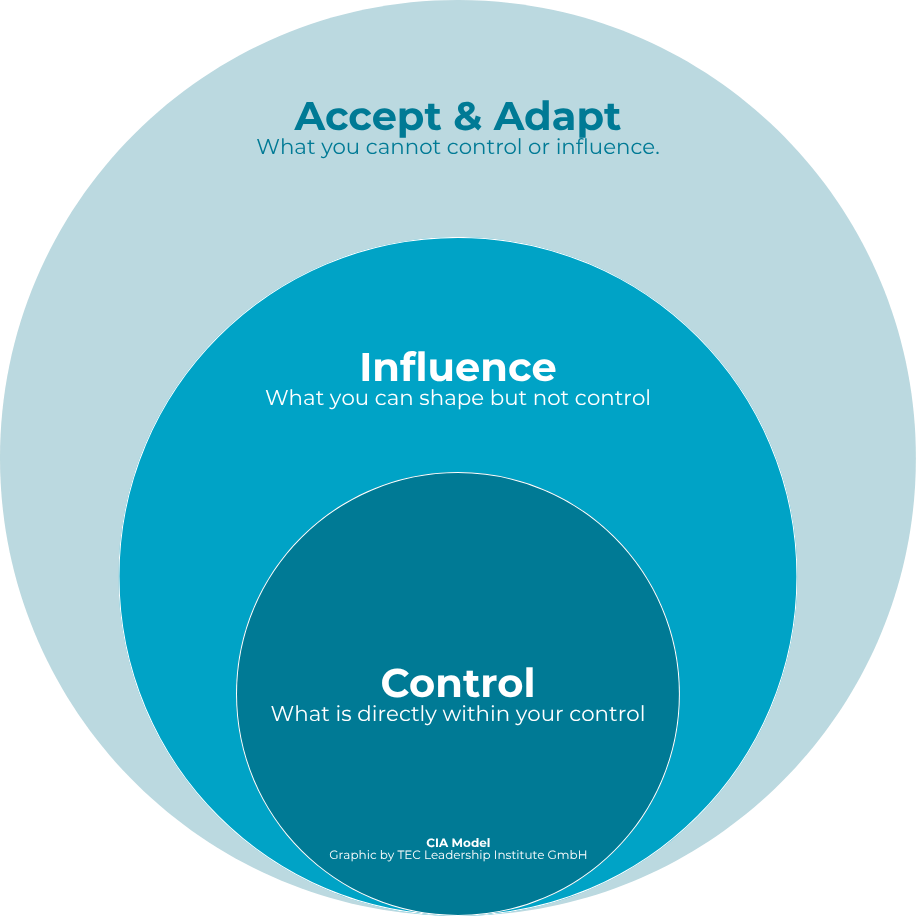
The CIA Model: focus your energy where it counts.
What are the benefits?
- Reduces anxiety and restores agency. Sorting worries into the three circles interrupts rumination and converts diffuse stress into concrete choices.
- Builds psychological safety. Naming worries openly makes them discussable; the team learns that concerns are worked with, not judged.
- Develops influence as the currency of modern leadership. In cross-disciplinary, interdependent organisations, very little sits within our personal control, we lead without line authority and depend on multiple stakeholders. The model shifts attention from “I can’t control this” to “who do I need, and how do I build the network and relationships to influence this?”
- Cuts the cost of change resistance. Teams are notorious for spending energy trying to keep things as they are. The model redirects that energy from questioning and maintaining towards accepting, adapting and acting.
- Creates empowerment. Energy moves from “if” to “how”, the fastest route back to focus, clarity and momentum.
How to use it
Step 1 — Surface the challenges
Ask: What feels difficult right now? What is keeping you up at night? Capture everything on sticky notes or a shared whiteboard. One worry per note, no filtering.
Step 2 — Sort into the three circles
- Control: What is genuinely within my own decision-making – my behaviour, priorities, responses and standards? Be honest: in an interdependent environment this circle is smaller than we like to think.
- Influence: What can I shape through others? Whose support do I need? Which relationships and networks must I build? This is usually the largest and most valuable circle for leaders.
- Accept & Adapt: What is simply here to stay? AI is a typical example: the question is not whether it is coming, but how we will work with it.
Step 3 — Move from “if” to “how”
For everything in the Accept & Adapt circle, the leader’s message to the team is: we are no longer asking if, we are asking how. Clarify the non-negotiables (the change itself) and the negotiables (how we implement it, the pace, the way we protect what matters to us). This distinction is what moves a team out of resistance and into the empowerment stage: What can we do? How will we do it? Where do we need to adapt?
Step 4 — Commit and revisit
Agree actions for the Control items, influencing strategies for the Influence items, and adaptation plans for the rest. Revisit regularly – in ongoing transformation, items move between circles as the situation evolves.
Further reading
Thompson, N. & Thompson, S. (2008). The Critically Reflective Practitioner. Palgrave Macmillan — the original source of the Control—Influence—Accept model.
Covey, S. R. (1989). The 7 Habits of Highly Effective People. Free Press — see the Circle of Concern and Circle of Influence (Habit 1: Be Proactive).
Lazarus, R. S. & Folkman, S. (1984). Stress, Appraisal, and Coping. Springer — the foundational psychology of how appraisal and perceived control shape our stress response.