Leadership Tool: Emotional Intelligence (EQ)
DIGITAL ARTICLE · 7 MIN READ
The capability that decides whether inclusive intent and adaptive strategy actually land.
By TEC Leadership Institute GmbH
What is emotional intelligence?
Edward Thorndike described a “social intelligence” as early as 1920, but the modern construct dates from 1990, when Peter Salovey and John Mayer defined emotional intelligence as the ability to monitor one’s own and others’ emotions and use that information to guide thinking and action. Reuven Bar-On coined “EQ” (Emotional Quotient) during his doctoral work in the 1980s and built the first validated measure, published in 1997 as the Emotional Quotient Inventory. Daniel Goleman then took the idea mainstream in 1995 and argued in What Makes a Leader? (1998) that intellect and technical skill are threshold requirements, while emotional intelligence is the sine qua non of leadership. The critical difference from IQ: EQ is learnable.
The EQ-i 2.0 — the assessment used in TEC programmes — turns this into something measurable and developable: five composites and fifteen subscales, scored against a global norm of 100. It describes behaviour, not personality type, which is precisely why it can be worked on.
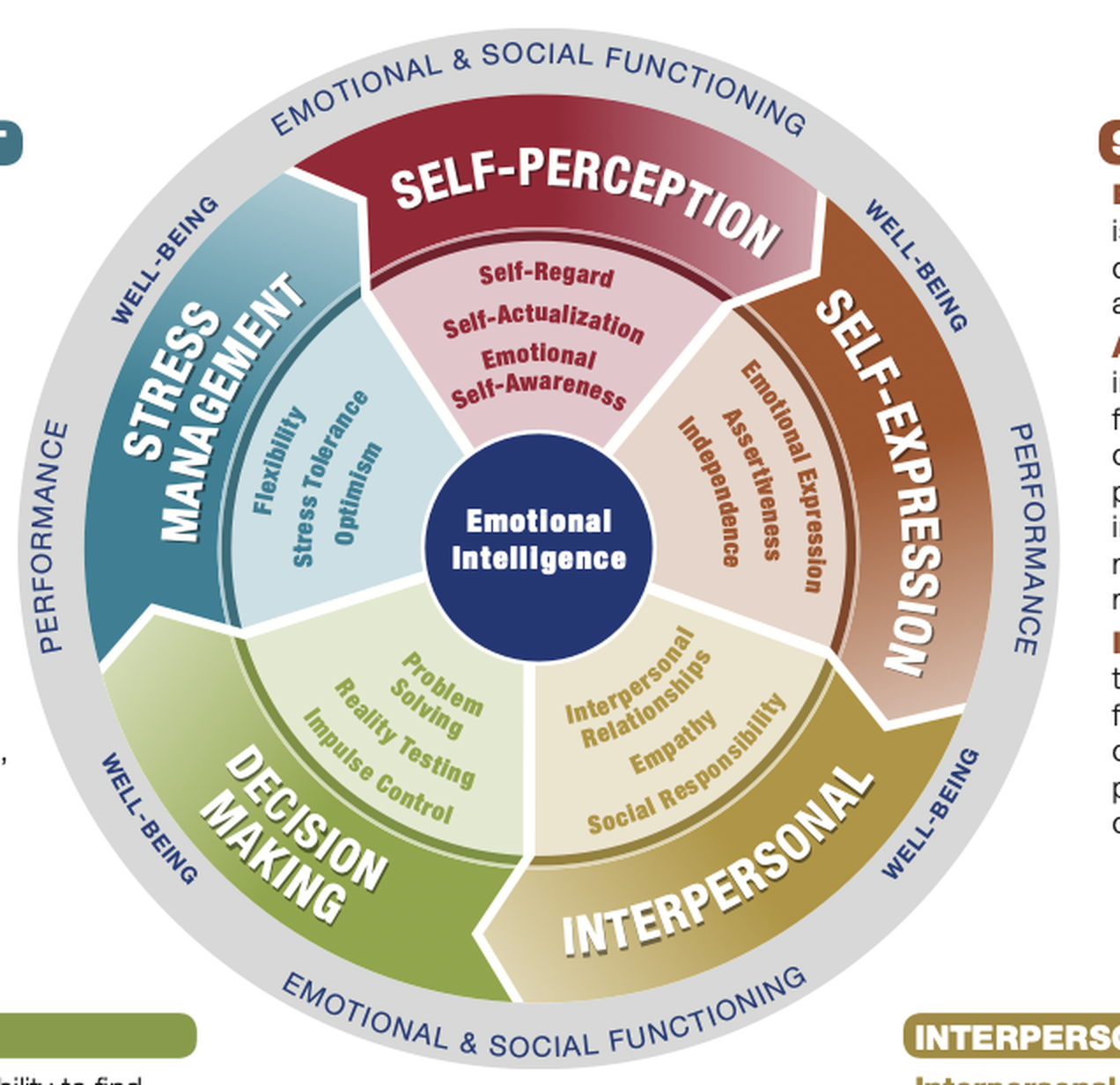
The EQ-i 2.0® model of emotional intelligence. © Multi-Health Systems Inc. Reproduced by TEC Leadership Institute GmbH as an accredited EQ-i 2.0 partner.
Self-Perception (self-regard, self-actualization, self-awareness) · Self-Expression (emotional expression, assertiveness, independence) · Interpersonal (relationships, empathy, social responsibility) · Decision Making (problem solving, reality testing, impulse control) · Stress Management (flexibility, stress tolerance, optimism).
Why EQ matters more in the age of AI
As artificial intelligence absorbs the analytical layer of leadership work, the scarce capability shifts to judgement, trust and mobilising people. The landmark field experiment by Dell’Acqua, Mollick and colleagues with 758 Boston Consulting Group consultants (2023) makes the point sharply. Inside what the authors call the “jagged technological frontier”, consultants using GPT-4 completed 12.2% more tasks, 25.1% faster, at markedly higher quality. On a complex managerial task deliberately chosen to sit outside that frontier, the same tool made them 19 percentage points less likely to reach the correct answer. The differentiator was not access to AI. It was the human judgement to know when to trust it.
The labour-market data agrees. The World Economic Forum’s Future of Jobs Report 2025 finds 39% of workers’ core skills will be disrupted by 2030, and names the top five core skills as analytical thinking; resilience, flexibility and agility; leadership and social influence; creative thinking; and motivation and self-awareness. Four of the five sit inside the EQ-i model — as does empathy and active listening, also in the top ten.
The implication is uncomfortable rather than reassuring. AI raises the floor on analysis, so analysis stops being a differentiator. What stays scarce is holding a room in disagreement, reading what is not being said, keeping a team steady when the plan changes for the third time in a quarter — and staying calibrated about your own reliability while a highly fluent machine agrees with you.
Why EQ is essential to inclusive leadership
Inclusion is an experience the team has, not an intention the leader holds — and the gap between the two is emotional, not procedural. Research by Bourke and Titus (Harvard Business Review, 2019), drawing on 3,500 employee ratings of 450 leaders, identified six inclusive behaviours and one persistent finding: leaders consistently overrate how inclusive they are. Deloitte’s associated research found teams with inclusive leaders are 17% more likely to report high performance, 20% more likely to say they make high-quality decisions, and 29% more likely to behave collaboratively. Every one of those behaviours runs through an EQ-i subscale.
- Empathy — articulating someone else’s experience accurately, especially when it differs sharply from your own. Without it, inclusion is a policy rather than a felt reality.
- Emotional Self-Awareness and Reality Testing — noticing your own reactions and testing them against evidence: the only reliable defence against unseen bias and against overrating your own inclusiveness.
- Interpersonal Relationships and Assertiveness — building enough trust that people bring dissent to you, and naming exclusion in the room rather than after the meeting.
- Flexibility — adapting how you communicate, recognise and involve people across culture, seniority and personality, instead of leading everyone as you would want to be led.
Why EQ is essential to adaptive leadership
Heifetz, Grashow and Linsky define adaptive leadership as “the practice of mobilizing people to tackle tough challenges and thrive”. Their central distinction is between technical problems, which existing expertise and authority can solve, and adaptive challenges, which require people to change values, habits, loyalties and beliefs — and therefore to absorb loss. Adaptive work generates distress by design. Regulating that distress, in yourself and in the system, is emotional work before it is strategic work.
- Get on the balcony — step off the dance floor to see the pattern. Draws on Reality Testing: seeing the system as it is, not as you wish it were.
- Diagnose before you act — genuinely adaptive, or a technical problem you are over-complicating? Problem Solving and Reality Testing keep the diagnosis honest.
- Hold the productive zone of disequilibrium — enough heat that people engage, not so much that they flee: Stress Tolerance applied to a whole team.
- Stay steady when the work is attacked — resistance is usually aimed at you personally. Self-Regard and Independence keep the issue in view without needing approval.
- Name the loss out loud — people resist loss, not change. Empathy makes it possible to say what people are giving up and be believed.
- Give the work back — resist rescuing the team with your own answer. Impulse Control stops a leader collapsing an adaptive challenge into a technical instruction.
- Sustain hope through the messy middle — Optimism as a disciplined stance: setbacks are temporary and specific, not permanent and total.
- Change your own default style — adaptive leadership asks the leader to adapt first; Flexibility makes every other shift on this list available to you.
How to develop EQ — deliberate practice
EQ improves, but not through insight alone. Goleman’s point is that emotional competence is seated in the limbic system, which learns through motivation, extended practice and feedback — not through reading about it. Development therefore looks like deliberate practice: one narrow behaviour, high repetition, immediate feedback, sustained over months rather than a workshop afternoon.
1 | Choose one subscale — not five. Work from your EQ-i profile and pick the largest imbalance, not the lowest score. A leader at Emotional Expression 123 and Empathy 105 has no empathy deficit — they have a gap that reads to the team as directive. That gap is the target. |
2 | Convert it into a behaviour you can do this week. “Be more empathetic” is not practisable. “Before my next three one-to-ones, write down what I think this person’s biggest pressure is, then open by checking it out loud” is. |
3 | Repeat it in real situations, and keep score. Keep a hit-and-miss journal: predict how a meeting will land emotionally, then record what actually happened. Misses are the data. Practise the harder version in routine meetings first — pressure narrows everyone back to their default style. |
4 | Engineer feedback — self-report is the weakest signal. Ask three people one specific question, not “how am I doing?” — for example, “In Tuesday’s meeting, did I shut down the alternative view too early?” Then thank them, and do not defend. |
5 | Re-measure after six to nine months. Retake the EQ-i or run a targeted 360. A few standard points of movement on a focused subscale is a real result; expecting transformation in a quarter is the fastest route to abandoning the practice. |
Worked examples by subscale
Emotional Self-Awareness A two-minute end-of-day log: what shifted my state today, and what did I do in the ten minutes after? | Impulse Control In decision meetings, hold your own position until at least two other people have spoken. |
Empathy In a disagreement, state the other person’s case until they confirm you have it right. | Assertiveness Before a difficult conversation, write your core outcome and your cave point — knowing where you will flex prevents rigidity. |
Further reading
Salovey, P. & Mayer, J. D. (1990). Emotional intelligence. Imagination, Cognition and Personality, 9(3).
Bar-On, R. (1997). The Emotional Quotient Inventory (EQ-i): Technical Manual. Multi-Health Systems — the origin of the EQ-i 2.0.
Goleman, D. (1995). Emotional Intelligence. Bantam; and “What Makes a Leader?”, HBR (1998).
Heifetz, R., Grashow, A. & Linsky, M. (2009). The Practice of Adaptive Leadership. Harvard Business Press.
Dell’Acqua, F., Mollick, E. et al. (2023). Navigating the Jagged Technological Frontier. HBS Working Paper 24-013.
Bourke, J. & Titus, A. (2019). Why Inclusive Leaders Are Good for Organizations. HBR, March 2019.
World Economic Forum (2025). The Future of Jobs Report 2025 — skills outlook to 2030.
FOR MORE INFORMATION, GET IN TOUCH
info@tec-leadership-institute.com · www.tec-leadership-institute.com