Leadership Tool: The Mutual Gains Approach
DIGITAL ARTICLE · 4 MIN READ
Negotiating value with stakeholders — because we are always negotiating.
By TEC Leadership Institute GmbH
We are always negotiating
In a matrix, global organisation, negotiation is not something that happens in a formal setting with contracts on the table. It happens every day: diverse stakeholders, each with their own agenda, objectives and constraints, deciding how much of their time, budget and goodwill to give your initiative. Every one of these interactions carries an implicit exchange — if they do something for you, you do something for them (the exchanging strategy from our article Leadership Tool: The Nine Influencing Strategies). The spirit is “I’m okay, you’re okay — let’s work this out together.” Leaders who understand the strategy behind these everyday negotiations, and choose their approach deliberately, consistently get more across the line.
Four negotiation strategies — and their push/pull dynamics
Every negotiation approach mixes two forces: push (advocating your own interests) and pull (drawing the other party towards you through understanding and co-creation). Four strategies cover most situations a matrix leader faces:
Strategy | Push / pull dynamic | When to use it |
|---|---|---|
Mutual gains | Balanced push & pull | Multi-stakeholder projects, regulatory discussions, sustainability initiatives —advocate your interests while co-creating solutions. |
Principled collaboration | Primarily pull | Stakeholder dialogue, influence and alignment — empathy, listening and joint problem-solving pull the other party into alignment without force. |
Focused subordination | Push (by them) / strategic pull | Negotiating with more senior stakeholders — yielding strategically to preserve long-term trust, while still framing the future. Use sparingly and consciously. |
Soft competition | Light push | Resource conflicts across teams — pursuing your interests firmly while keeping the tone cooperative and non-confrontational. |
One caution: within a mutual gains negotiation, subordination has no place — you should neither expect stakeholders to subordinate themselves to you, nor subordinate your own needs to theirs. Focused subordination is a separate, occasional tool for clearly asymmetric situations; if it becomes your default, you are giving value away.
The Mutual Gains Approach in depth
The Mutual Gains Approach (MGA) was developed by Lawrence Susskind and colleagues at the MIT–Harvard Program on Negotiation, building on the interest-based negotiation tradition of Fisher and Ury’s Getting to Yes. Its core claim: negotiations that focus on mutual gains reach agreement with challenging counterparts while creating value — expanding the pie before dividing it — rather than merely trading concessions. It is ideal for multi-stakeholder projects, regulatory discussions and sustainability initiatives, where many parties must stay in the relationship long after the deal. It works in four steps:
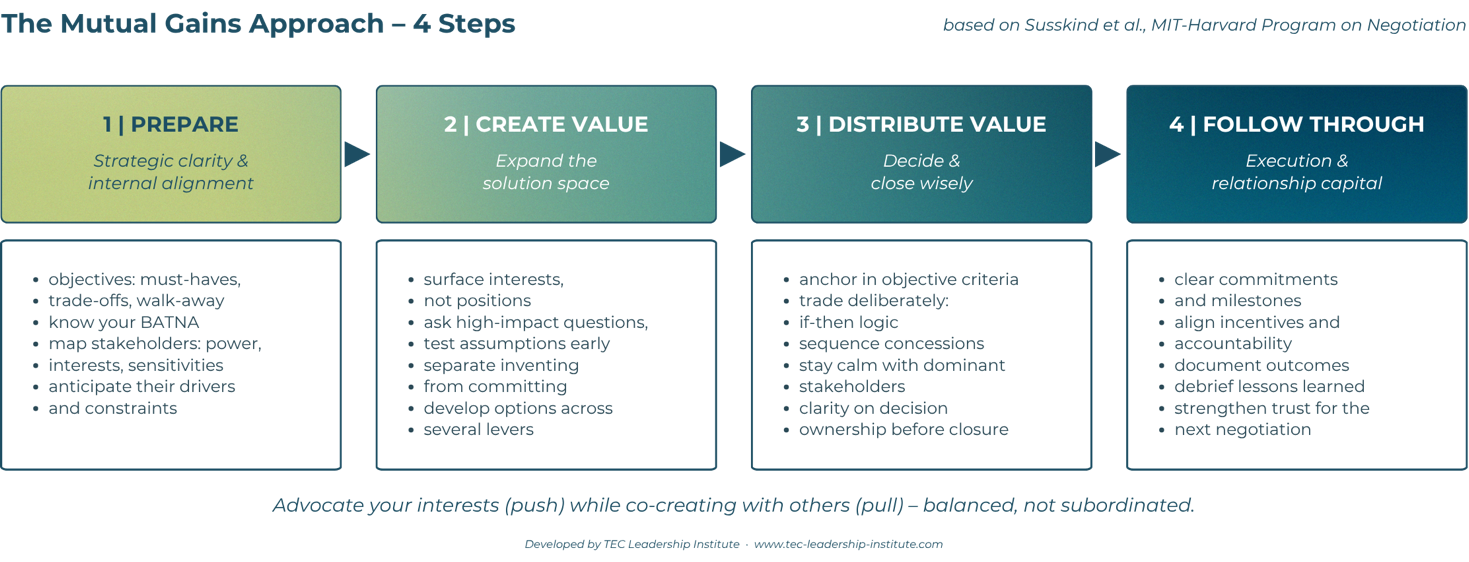
The four steps of the Mutual Gains Approach.
Applying it — and getting stakeholders to see the benefit
• Prepare more than they do. Most negotiation value is won before the first meeting: know your must-haves, trade-offs and walk-away point, and map every stakeholder’s interests, power and constraints. Anticipating their drivers is what lets you propose options they can say yes to.
• Open with interests, invite theirs. State openly what matters to you and why, and ask the same: “help me understand what a good outcome looks like for you.” Transparency about interests invites transparency in return — and turns opponents into problem-solvers.
• Expand before you divide. Generate options together before committing to any of them — across timing, scope, visibility, risk-sharing and resources. A cross-functional platform project, for example, unlocks when IT gets its architecture standard, the business unit gets its launch date, and compliance gets an early review slot: three interests, one package.
• Trade with if—then logic. “If you can commit two experts for Q3, then we will fund the integration work.” Deliberate, conditional trades distribute value without eroding the relationship.
• Follow through visibly. Deliver your side, document commitments, and debrief. Every kept commitment builds the trust capital (see Leadership Tool: The Three Cs of Trust) that makes the next negotiation easier — in a matrix, you always negotiate with the same people again.
Further reading
• Fisher, R., Ury, W. & Patton, B. (2011). Getting to Yes (3rd ed.). Penguin — the foundation of interest-based negotiation.
• Susskind, L. & Field, P. (1996). Dealing with an Angry Public: The Mutual Gains Approach. Free Press — the original formulation of MGA.
• Program on Negotiation, Harvard Law School — www.pon.harvard.edu — free articles and research on negotiation strategies, including mutual gains.