Leadership Tool: The Nine Influencing Strategies
DIGITAL ARTICLE · 5 MIN READ
Winning commitment when influence is your only currency.
By TEC Leadership Institute GmbH
Why influencing is the leadership skill of the matrix
In a matrix, often global, organisation, most of the people you depend on do not report to you. To get stakeholders to work towards your objectives — or deliver their part in coalition with you — influence is your only currency. And influence rests on a foundation we covered in our companion article Leadership Tool: The Three Cs of Trust: without trust, none of the strategies below work for long. With trust in place, the question becomes: which influencing strategy do I choose, for whom, and when?
The nine strategies — what the research found
In 1980, psychologists David Kipnis, Stuart Schmidt and Ian Wilkinson studied how people in organisations actually “get their way”, and turned the findings into a measurement instrument that Gary Yukl and colleagues refined over the following three decades. The result is a robust map of nine influencing strategies. Three are “hard” tactics, built on the leader’s own perspective: requesting (direct demands), legitimating (invoking policy, rules or mandate) and coalition (enlisting the support of others). Six are “soft” tactics that increasingly build on the other person’s perspective: rational persuasion, socializing, personal appeals, exchanging, consultation and — the most personal of all — inspirational appeals, which speak to the other person’s values and emotions.
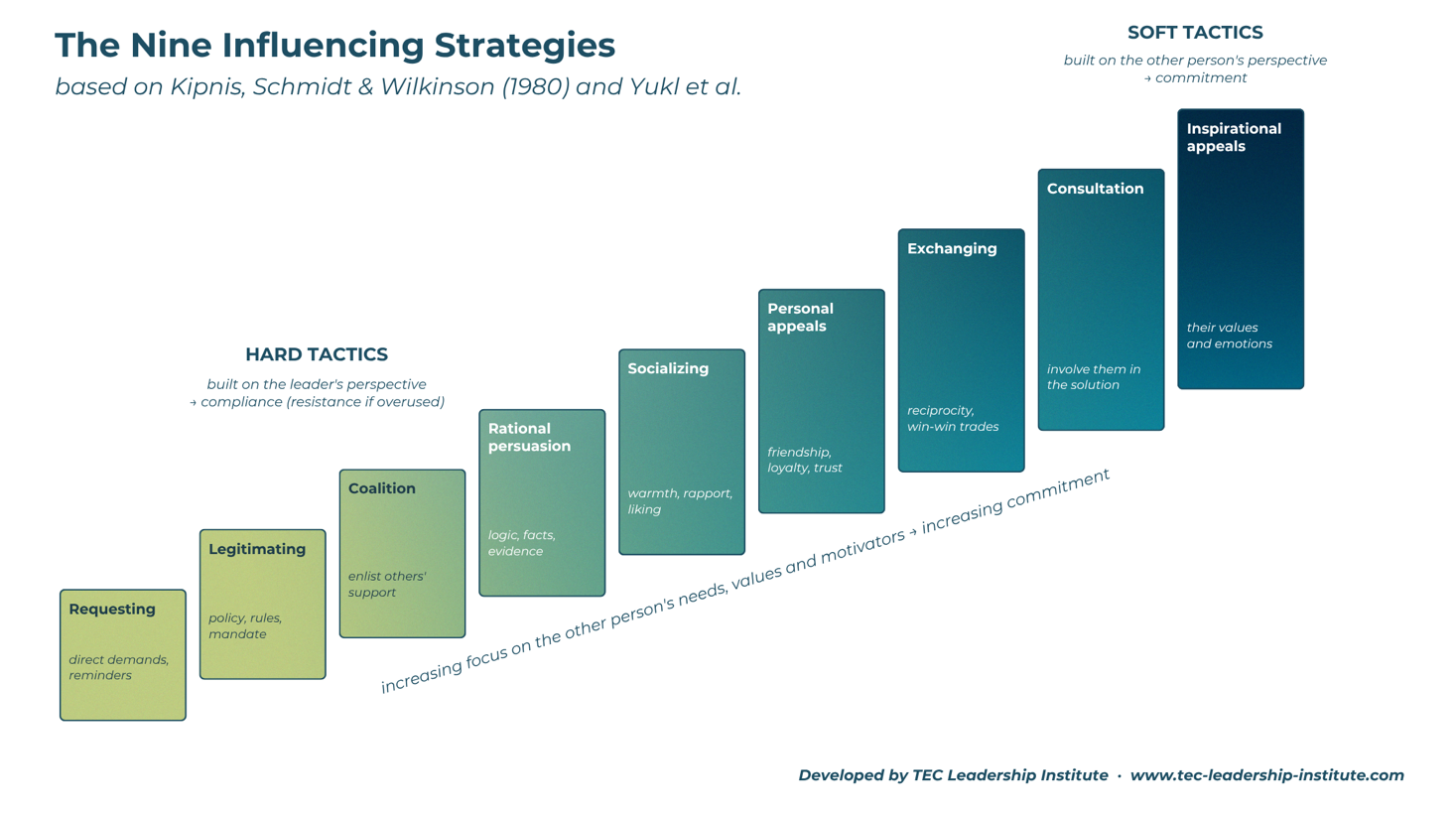
The nine influencing strategies: the further right, the more commitment they create.
Commitment, compliance or resistance?
Research distinguishes three outcomes of any influence attempt: commitment (the person internally agrees and brings initiative, energy and persistence), compliance (they do it, apathetically, and give up at the first obstacle) and resistance (they oppose, delay or undermine). The landmark study by Falbe and Yukl (1992) delivered a finding every matrix leader should know: the strategies that create the most commitment — inspirational appeals and consultation, with personal appeals close behind — are used the least, each in only around 2% of real influence attempts. Meanwhile rational persuasion, used in over half of all attempts, mostly produces mere compliance. And the hard tactics — pressure, legitimating and coalition — provoke the most resistance when overused. In short: most leaders default to the strategies that work worst, and neglect the ones that work best.
Building the three commitment strategies
• Inspirational appeals. These require knowing what the other person values — which means investing in the relationship first. Link your request explicitly to their ideals and motivations (“because you care about developing people, I’d like you to lead this mentoring initiative”), paint the picture of what success looks like, and be authentic: manufactured inspiration is spotted instantly.
• Consultation. Involve people in shaping the solution before it is fixed: “here is my suggestion — what would you change?” Genuinely incorporate their input and say what you took on board. Ownership is the strongest driver of commitment; people rarely resist what they helped design.
• Personal appeals. These draw on friendship, loyalty and history — a trust account you must fill long before you draw on it. Invest in relationships across the matrix systematically, not transactionally, and when you ask, ask personally: “I need your help on this one.”
When compliance is enough — the hard tactics, used well
• Legitimating: frame the legitimacy. For routine, standard or urgent matters, anchoring a request in policy, governance decisions or a sponsor’s mandate is fast and perfectly legitimate — “the steering committee has decided” saves everyone a debate.
• Coalition: build powerful networks. Across organisations and stakeholders, strong networks are a strategic asset — and coalitions are how change spreads. As described in our article Leadership Tool: The Change Adoption Curve, trusted peers and early adopters carry a message further than any leader can alone. Build the coalition before the meeting, not in it.
• Requesting / pressure: use with caution. Direct demands work for simple, clear, urgent tasks — and in genuine emergencies they are the right choice. But as a default style they produce compliance at best and resistance at worst, and they quietly drain the trust account every time they are used.
Further reading
• Kipnis, D., Schmidt, S. M. & Wilkinson, I. (1980). Intraorganizational influence tactics: Explorations in getting one’s way. Journal of Applied Psychology, 65(4), 440–452 — the original research.
• Falbe, C. M. & Yukl, G. (1992). Consequences for managers of using single influence tactics and combinations of tactics. Academy of Management Journal, 35(3), 638–652 — which tactics create commitment, compliance and resistance.
• Feser, C. (2016). When Execution Isn’t Enough. Wiley — an accessible synthesis of the influence research for leaders.
• Cialdini, R. B. (2021). Influence: The Psychology of Persuasion (new & expanded ed.). Harper Business — the psychological principles underneath the tactics.